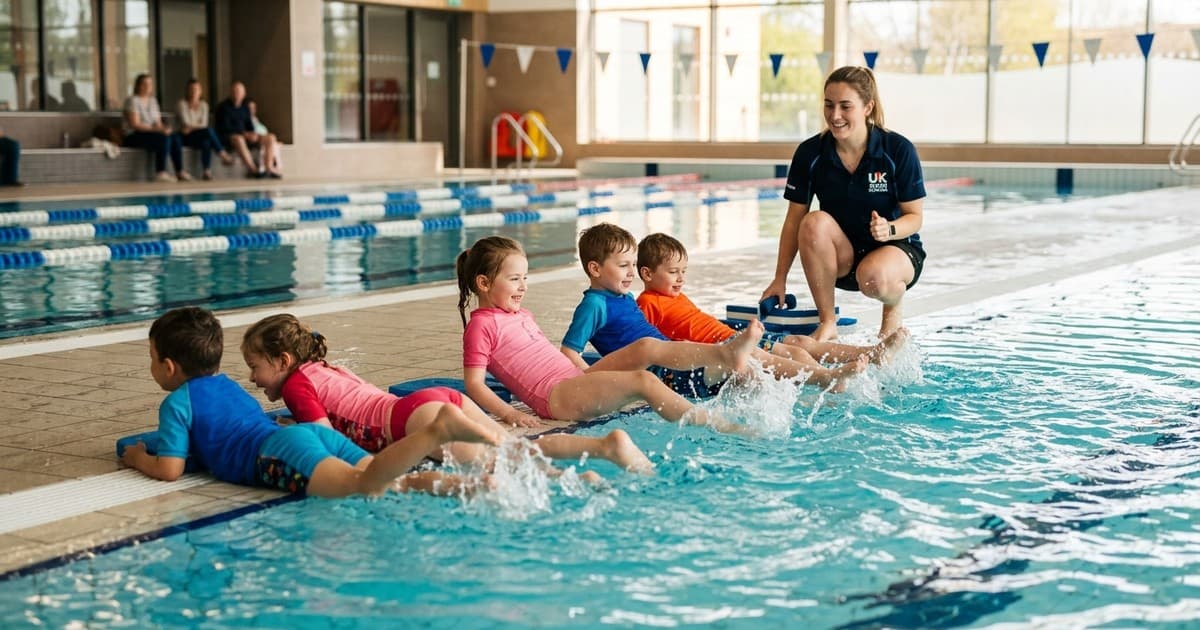
Why Swimming Is the Strongest Market in Children's Activities
Swimming is unique among children's activities because it is both a sport and a survival skill. Parents do not just want their children to swim. They need them to. This creates consistent, year-round demand that is less sensitive to economic conditions than almost any other activity.
According to Swim England, around one in three children leaves primary school unable to swim 25 metres, the National Curriculum standard. This gap between parental aspiration and school provision creates an enormous market for private swimming schools.
Choosing Your Affiliation: Swim England or STA
Two national bodies serve UK swim teaching: Swim England and the Swim Teachers Association (STA). You can affiliate with either — or both — depending on the qualifications you hold and the brand recognition you want with parents.
Swim England
- Access to the Learn to Swim programme and its nationally recognised framework of Stages 1-7 (plus pre-school stages)
- Insurance cover through Swim England's block policy (public liability, professional indemnity, and personal accident)
- Use of the Swim England brand and quality mark
- Access to CPD training and development opportunities
- DBS checking services
- A listing in the Swim England pool finder, which is a source of organic enquiries
The annual affiliation fee is modest (currently around £120-£200 for a swim school, plus per-member fees), and the credibility it provides is worth many times the cost.
Swim Teachers Association (STA)
- Access to the STA International Learn to Swim Programme with Awards 1–7 plus Tots and Adult progressions, recognised in the UK and over 35 countries
- Insurance cover via STA Plus membership (public liability, professional indemnity, and personal accident)
- Use of the STA brand and the "STA School" mark
- CPD, safeguarding, and rescue training (Safety Award for Teachers, equivalents to NRASTC)
- DBS service for teachers and assistants
- A listing in the STA "Find a Pool" directory
STA membership starts at a similar price point to Swim England and is widely accepted by pool operators and parents. Many teachers and schools hold both affiliations to maximise flexibility and brand recognition.
Qualifications You Need
To teach swimming in the UK, you need at minimum:
- Swim England Level 2 Teaching Swimming: This is the industry-standard qualification for teaching children and adults. It replaced the old ASA Level 2. The course takes around 6-8 days plus assessment and costs approximately £300-£500.
- STA Level 2 Certificate in Teaching Swimming: An equally recognised industry-standard qualification, accepted by most pool operators and insurers. Comparable in scope and cost to the Swim England Level 2 (around £400–£600 for the full course and assessment).
- STA Award in Swimming Teaching: An entry-level teaching qualification suitable for assistant teachers — comparable to the Swim England Level 1.
- STA Baby & Pre-School Award: A specialist qualification for teaching swimming to babies, toddlers, and pre-school children — useful if you plan to enter that lucrative end of the market.
- Level 1 Teaching Aquatics: A prerequisite for Level 2 or a standalone qualification for assistant teachers.
- National Rescue Award for Swimming Teachers and Coaches (NRASTC): A poolside rescue qualification. Many pools require this before allowing you to teach. It must be renewed every two years.
- First aid certificate: STA or equivalent, renewed every three years.
- Enhanced DBS check with children's barred list.
- Safeguarding and Protecting Children course (available through Swim England).
If you plan to teach babies and toddlers (a lucrative market), additional qualifications are available, such as the STA Baby and Pre-school certificate or Water Babies/Puddle Ducks franchised training (if going the franchise route).
Finding and Securing Pool Time
Pool access is the biggest challenge for new swimming schools and will likely be your largest cost.
Types of Pool Access
- Local authority leisure centres: The most common option. You hire lane time or whole-pool time. Costs vary enormously by area, from £30-£80 per hour for lane hire to £100-£300+ per hour for exclusive use of a pool.
- School pools: Many primary and secondary schools have pools they are willing to hire out during evenings and weekends. Often cheaper than leisure centres, with less competition for slots.
- Private pools: Hotels, health clubs, and private estates sometimes hire out pool time. Premium pricing but often a better teaching environment.
- Your own facility: Purpose-built teaching pools (typically smaller and warmer than public pools, around 12-15m x 6m, heated to 30-32 degrees Celsius) are the gold standard but require significant capital investment.
Pool Requirements for Teaching
- Water temperature: 28-30 degrees Celsius for children's lessons, 30-32 degrees for babies and toddlers
- Depth: Ideally a range from 0.6m to 1.5m for a general teaching pool
- Changing facilities: Adequate and accessible, including family changing where possible
- Poolside access: Sufficient space for equipment storage, parent viewing where appropriate, and emergency access
Teacher-to-Student Ratios
Both Swim England and the STA publish very similar maximum ratios. The figures below reflect the common UK industry guidance:
- Babies and toddlers (with parent in water): 1 teacher to 12 pairs
- Pre-school (3-5 years, without parent): 1 teacher to 4 children
- Beginners (school age): 1 teacher to 6 children
- Improvers: 1 teacher to 8-10 children
- Confident swimmers / squads: 1 teacher/coach to 12-20 swimmers
These ratios directly affect your pricing and profitability. Beginner classes have lower ratios (higher instructor cost per child) and should be priced accordingly.
Curriculum and Progression
Two leading curricula are widely used in the UK: the Swim England Learn to Swim Pathway and the STA International Learn to Swim Programme. Both run from water-confidence stages through structured progression awards. Either is a defensible choice — what matters most is consistency of assessment and clear communication with parents.
The Swim England Learn to Swim Pathway is the most widely used framework and the one parents recognise. It runs from Discovery stages (water confidence for babies) through Stages 1-7 (non-swimmer to competent swimmer) and into the competitive and synchro pathways.
The STA International Learn to Swim Programme runs through Awards 1–7 (plus Tots, Adult, and Survival awards). Each award has clearly defined skills and is supported by STA-issued certificates and badges. The programme is recognised by pool operators across the UK and is the framework of choice for many private swim schools, particularly those teaching babies and pre-schoolers.
Whichever framework you choose, AMES supports either pathway out of the box, with assessment checklists and badge generation aligned to your selected programme. Schools running mixed cohorts can configure both side-by-side.
Using a recognised framework gives you:
- A clear structure parents can understand and follow
- Defined assessment criteria for each level
- Certificates and badges that motivate children (Swim England provides these)
- A basis for grouping students by ability rather than age
Track every student's progress systematically. AMES includes skill tracking and assessment features specifically designed for swimming schools, so instructors can record progress poolside and parents can see their child's development through the parent portal.
Pricing Your Swimming School
Swimming lessons command premium pricing compared to most other children's activities, reflecting the essential nature of the skill and the high venue costs.
- Group lessons (30 minutes): Typically £8-£15 per child depending on location and class size
- One-to-one lessons (30 minutes): £20-£40, sometimes higher in London and the South East
- Baby swimming (30 minutes): £10-£18, often at the higher end because of the warm water and specialist instructor requirement
- Intensive courses (4-5 consecutive days): £50-£80 per child, popular during school holidays
Most swimming schools sell in term blocks (10-14 weeks) with payment upfront, or offer monthly direct debit. Block booking gives you predictable cash flow and higher attendance rates.
Actionable Takeaways
- Decide which body to affiliate with — Swim England, the STA, or both, and start the application now. If you already hold an STA Level 2 you do not need a Swim England Level 2 to teach.
- Approach at least five venues for pool hire. School pools are often overlooked and can offer the best value.
- Calculate your cost per lesson slot carefully, factoring in pool hire, your time, insurance, equipment, and Swim England fees. Price above this with a margin that sustains your business.
- Set up your booking system before you launch so that your first enquiry can convert to a booking immediately.