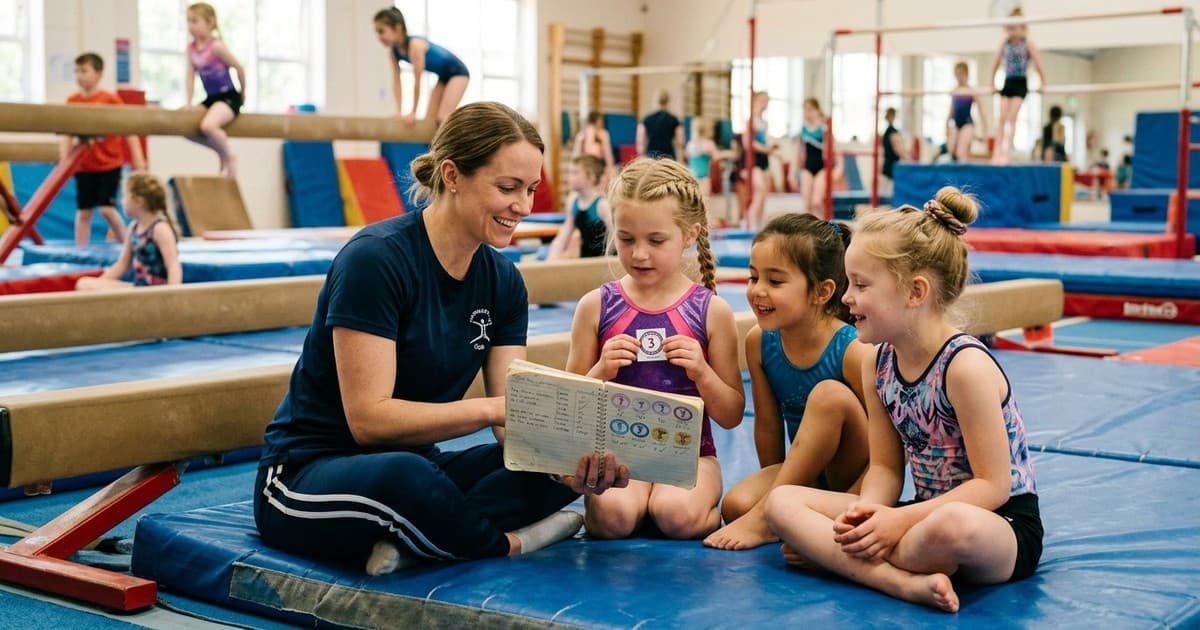
The Importance of Badge Progression in Gymnastics
Badges and awards are not just bits of fabric and ribbon. They are one of the most powerful retention tools a gymnastics club has. For children, earning a badge provides tangible proof of progress. For parents, it justifies the ongoing cost of sessions. For coaches, it creates structured milestones that keep lesson planning purposeful.
British Gymnastics operates a comprehensive proficiency award scheme that most clubs use as the backbone of their recreational programme. The scheme runs from Proficiency Badge 1 through to Badge 8, with each level requiring demonstrated competency in floor, vault, bars (or rings), and beam skills. Beyond the core badges, BG offers specialist floor and vault awards, as well as the Challenge Awards for more advanced recreational gymnasts.
Many clubs supplement the BG scheme with their own internal awards. These might include effort awards, attendance milestones, flexibility achievements, or conditioning targets. The combination of national and club-level recognition creates a rich progression pathway that keeps gymnasts engaged across many years.
The challenge is tracking all of this efficiently, particularly when your club has hundreds of gymnasts across dozens of classes.
Building an Efficient Tracking System
The days of coaches keeping badge records in exercise books or on loose sheets of paper should be firmly behind us. Paper systems lose data, create single points of failure, and make it impossible to provide parents with timely information about their child's progress.
What to Track
At minimum, your tracking system should record: the gymnast's name and group, the specific badge or award being worked towards, the individual skills within that badge (with a record of which have been achieved and which are still in progress), the date each skill was signed off, the coach who assessed it, and the date the badge was formally awarded. For BG proficiency awards, the system should mirror the skill requirements published by British Gymnastics so coaches can reference the exact criteria during assessment.
Digital Tracking Solutions
A digital tracking system transforms badge management from a time-consuming chore into a streamlined process. Coaches can update skill records on a tablet at the end of each session, and the data is immediately available to other coaches, to administrators for ordering, and to parents through a portal or app. AMES provides badge and progression tracking specifically designed for activity clubs, allowing coaches to mark off individual skills, trigger badge completions automatically, and give parents real-time visibility into their child's journey.
Avoiding Common Tracking Mistakes
The most common mistake clubs make is tracking badges only at the badge level (achieved or not achieved) rather than at the skill level. This gives parents no visibility into how close their child is to the next badge, and it makes it harder for coaches to plan sessions around the specific skills their group needs to develop. Track every individual skill within every badge for every gymnast. It sounds like a lot, but with a digital system it takes coaches less than two minutes per session to update.
The second most common mistake is inconsistent assessment standards, which links directly to the ability group management discussed in other guides. If Coach A signs off a cartwheel that Coach B would not, the badge loses its meaning. Use the moderation process described in your assessment framework to keep standards consistent.
Bulk Ordering and Inventory Management
Badge ordering is a surprisingly significant administrative task in a large gymnastics club. Get the timing or quantities wrong, and you either have gymnasts waiting weeks for their badge (which kills the motivational impact) or you have hundreds of pounds of unsold stock sitting in a cupboard.
Forecasting Demand
Use your tracking data to forecast badge orders. If you can see that 15 gymnasts across your Tuesday and Thursday recreational classes are within two skills of completing Badge 3, you know you need at least 15 Badge 3 awards within the next half-term. Order ahead of demand, not in response to it. Most clubs find that placing orders termly, based on tracking data from the previous term, strikes the right balance between responsiveness and efficiency.
Ordering from British Gymnastics
BG proficiency awards are ordered through the British Gymnastics online shop. Delivery typically takes one to two weeks, but can be longer during busy periods (September and January are peak times as new gymnasts join and existing gymnasts progress). Clubs registered with British Gymnastics receive trade pricing on bulk orders. Keep a buffer stock of the most commonly awarded badges, particularly Badges 1 through 4, which have the highest turnover in recreational programmes.
Managing Costs
Decide early whether badge costs are included in your session fees or charged separately. Most clubs include the cost within their termly or monthly fees, which simplifies administration and avoids the awkwardness of chasing individual payments for small amounts. Factor the average badge cost per gymnast per term into your pricing model. For a recreational gymnast progressing at a typical rate, this averages between three and five pounds per term.
Presentation Ceremonies and Recognition
How you present badges matters almost as much as the badge itself. A badge handed over in a plastic bag at the end of a session has nowhere near the motivational impact of a badge presented in a brief ceremony with applause and recognition.
In-Session Presentations
The simplest approach is to dedicate the last five minutes of the final session each half-term to badge presentations. Gather the group, call out each gymnast who has earned a badge, and have them collect it from the coach in front of their peers. Parents who are watching from the viewing gallery see their child recognised, which reinforces the value of the programme. Keep it brief, genuine, and enthusiastic.
Termly Award Events
Some clubs hold a termly or annual award ceremony, often combined with a display or showcase where gymnasts perform for their families. This creates a community event that strengthens the club's culture and provides an opportunity for additional recognition beyond badges, such as coach's awards, most improved gymnast, sportsmanship awards, or effort awards. These events also serve as excellent opportunities for photography and social media content, with appropriate consent in place.
Digital Certificates
Supplement physical badges with digital certificates that parents can download or share. A well-designed PDF certificate with the gymnast's name, the badge earned, and the date creates a lasting record and gives parents something to share on social media, which is valuable free marketing for your club. AMES can generate these automatically when a badge is marked as awarded in the system.
A badge programme is only as motivating as the experience around it. The tracking, the presentation, and the parent visibility all matter as much as the badge itself.
Key Takeaways
- Track individual skills within each badge, not just badge-level completions, to give parents visibility into progress and help coaches plan targeted sessions.
- Use a digital tracking system so coaches can update records in real time and parents can view progress through a portal.
- Order badges termly based on tracking data forecasts, and keep buffer stock of the most common badges.
- Include badge costs in session fees to simplify administration and avoid chasing small individual payments.
- Present badges in brief, genuine ceremonies with peer recognition rather than handing them out informally.
- Supplement physical badges with downloadable digital certificates that parents can share.