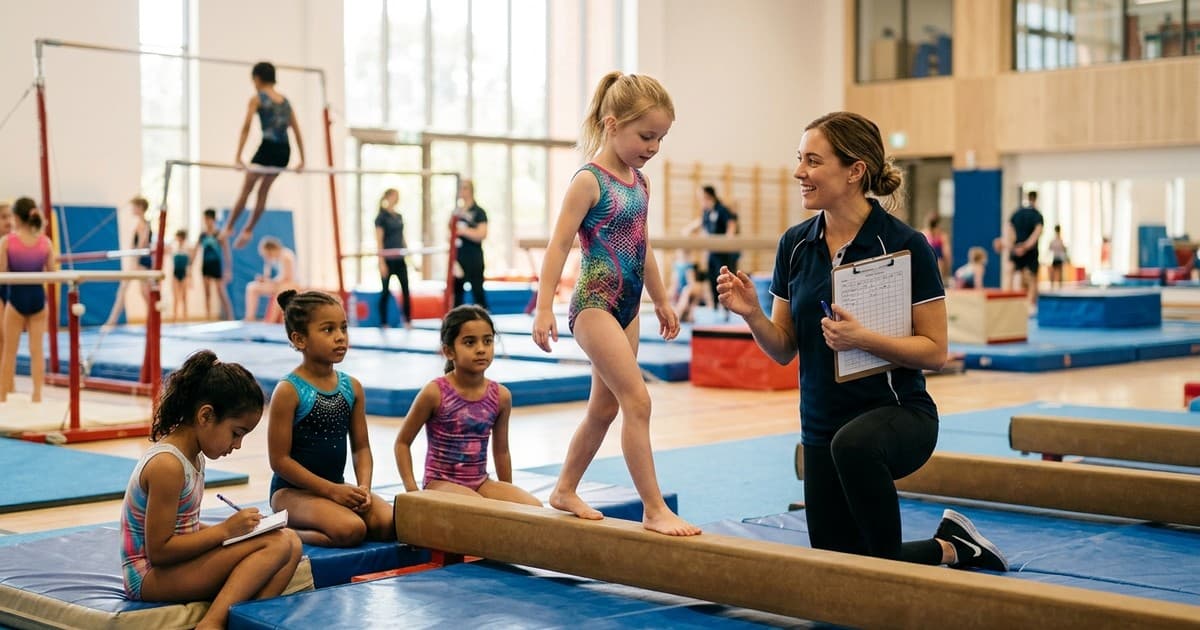
Why Ability Group Placement Matters
In any gymnastics club, the difference between a well-placed gymnast and a misplaced one is significant. A child placed in a group beyond their current ability faces genuine safety risks. Gymnastics involves apparatus work, aerial skills, and complex body movements where strength-to-weight ratios and spatial awareness matter enormously. A child who is not developmentally ready for a specific skill is not just going to struggle; they could get hurt.
Equally, a gymnast placed in a group below their ability quickly becomes bored and disengaged. They stop enjoying sessions, and their parents start asking questions. In both cases, the club's reputation suffers, and retention drops.
British Gymnastics provides a framework through its proficiency awards and badge schemes, but the practical reality of group placement in a busy club requires much more than ticking boxes on a skills checklist. It requires a structured, transparent system that coaches trust, parents understand, and children experience as fair.
This guide walks through how to build that system from the ground up.
Designing Your Assessment Workflow
The foundation of consistent group placement is a documented assessment process that every coach follows in the same way. Without this, you end up with subjective decisions that vary from coach to coach, which is the single biggest source of parent complaints in gymnastics clubs.
Define Your Ability Levels Clearly
Start by mapping your club's group structure to specific, observable skills. Most recreational gymnastics clubs operate four to six ability levels. For each level, list the entry-level skills a gymnast must demonstrate and the exit skills they should achieve before moving up. Keep descriptions precise and observable. "Good body tension" is subjective. "Can hold a straight body shape for five seconds in a dish position on the floor" is assessable.
Align these levels with the British Gymnastics Proficiency Awards where possible. The BG badge scheme (Badges 1 through 8 for recreational gymnastics, and the separate floor and vault awards for more advanced work) gives you a nationally recognised benchmark. However, many clubs find they need intermediate steps between BG badge levels, particularly between Badges 3 and 5 where the skill jumps are significant.
Structured Taster Sessions
Every new gymnast should attend a taster session before being placed in a regular class. This is non-negotiable for safety. A taster session serves three purposes: it lets the coach assess the child's current ability, it lets the child experience the club environment, and it gives parents realistic expectations about where their child will start.
Design your taster sessions to include a standardised warm-up, a floor skills circuit (forward roll, backward roll, cartwheel, handstand against the wall), a balance beam sequence at low height, and basic bar work (hanging, swinging, pulling up). Use a simple scoring rubric for each station. A coach should be able to complete an assessment form in under ten minutes after a 45-minute taster.
The Role of Age and Physical Development
Ability is not the only factor. A tall, strong 12-year-old with no gymnastics experience is a very different placement challenge from a small, flexible 6-year-old with two years of pre-school gymnastics. Physical maturity affects what apparatus and skills are appropriate, and it affects group dynamics. British Gymnastics guidance on age-appropriate training loads should inform your placement decisions, particularly around hours per week and the introduction of impact skills.
Ensuring Consistency Across Coaches
The most common failure in ability group placement is inconsistency. Coach A thinks a child is ready to move up; Coach B disagrees. Parents notice immediately, and it erodes trust.
Moderation Sessions
Run termly moderation sessions where coaches assess the same group of gymnasts independently and then compare results. This is standard practice in education and works brilliantly in gymnastics. Discrepancies highlight where your criteria are ambiguous, and the discussion process builds shared understanding. Allow two hours per moderation session, and rotate which coaches attend so everyone calibrates against everyone else over the course of a year.
Video Evidence
For borderline cases, short video clips of a gymnast performing the relevant skills provide objective evidence that can be reviewed by multiple coaches. This is particularly valuable when a parent disputes a placement decision. You are not relying on one coach's memory of a single session; you have documented evidence. Ensure your photography and video consent forms cover assessment recordings, and store footage securely in line with GDPR requirements.
Written Criteria, Not Coach Intuition
Every placement decision should be traceable to your documented criteria. When a coach recommends a move-up, they should be able to point to the specific skills the gymnast has demonstrated. When a parent asks why their child is in a particular group, the answer should reference concrete abilities, not vague impressions. This protects the coach, the club, and the child.
Communicating Placement Decisions to Parents
Parent communication around ability placement is emotionally charged. Every parent believes their child is talented, and some will push hard for advancement before the child is ready. Your communication strategy needs to be proactive, transparent, and empathetic.
Set Expectations Early
From the first point of contact, make it clear that group placement is based on assessed ability and is reviewed regularly. Include this in your welcome pack, on your website, and in the conversation at the end of every taster session. When parents understand from day one that placement is structured and evidence-based, they are far less likely to challenge it later.
Regular Progress Updates
Parents who receive regular updates about what their child is working on and what they have achieved are far more patient about group progression than parents who hear nothing for months and then get told their child is not ready to move up. A simple termly progress summary, even just a few bullet points per child, transforms the parent relationship. Digital platforms like AMES make this scalable by letting coaches log skills and badges that parents can view in real time.
Handling Disputes Gracefully
When a parent disagrees with a placement, listen first. Often they have information you do not, such as the child practising at home or attending a different club. Offer to reassess. If the reassessment confirms the original placement, explain the specific skills the child needs to develop and give a realistic timeline. If the parent remains unsatisfied, offer a trial session in the higher group with the explicit understanding that safety is the priority and the coach will make the final call. Most parents, when they see the skill gap in person, accept the decision.
The goal is not to win the argument. The goal is to keep the child safe, keep the parent engaged, and keep the gymnast progressing at the right pace.
Key Takeaways
- Map every ability group to specific, observable skills aligned with British Gymnastics proficiency levels.
- Require structured taster sessions for all new gymnasts before placing them in regular classes.
- Run termly moderation sessions so coaches calibrate their assessments against each other.
- Use video evidence for borderline placement decisions and to support parent communication.
- Communicate proactively with parents through termly progress updates and clear expectations from day one.
- Handle placement disputes with empathy, evidence, and the offer of a supervised trial in the higher group.