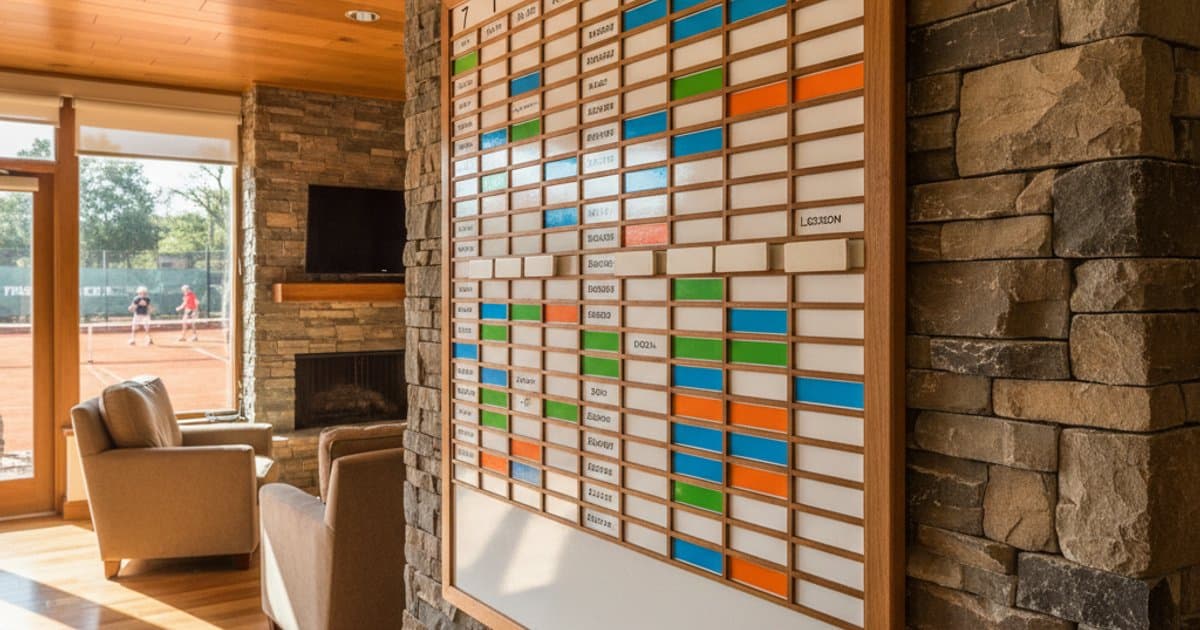
Why Court Scheduling Deserves Strategic Attention
Most tennis clubs treat court scheduling as an administrative task: someone opens the booking sheet, people book courts, conflicts get resolved as they arise. But court scheduling is actually a strategic function that directly affects revenue, member satisfaction, facility lifespan, and coaching programme quality.
Consider this: a six-court club with floodlights operating 14 hours per day has 84 court-hours of capacity. If your average utilisation is 40 per cent (which is typical for many UK clubs), you are using 34 court-hours and leaving 50 unused. Improving utilisation to 55 per cent, an achievable target with better scheduling, adds 13 court-hours per day. At even modest per-hour revenue, that represents significant additional income.
Smart scheduling is not about filling every court every hour. It is about maximising the value extracted from your available capacity while keeping members satisfied and courts in good condition.
Surface Management Through Scheduling
If your club has courts of different surface types, your scheduling should account for their different maintenance needs and playing characteristics.
Rotating Court Usage
Coaching programmes tend to cluster on the same courts because coaches develop preferences and habits. This concentrates wear on a subset of your courts while others sit underused. A rotation policy, where coaching moves to different courts on a weekly or fortnightly cycle, distributes wear and extends the life of all your surfaces.
For clubs with both hard and artificial grass courts, consider scheduling higher-intensity activities (coaching drills, cardio tennis) on harder-wearing surfaces and reserving more delicate surfaces for match play and social tennis where wear patterns are more distributed.
Maintenance Windows
Every court surface requires regular maintenance, and this needs to be scheduled as firmly as any coaching session. Artificial grass courts need brushing, hard courts need cleaning and occasional repainting, and clay courts need daily watering and line sweeping. Block out maintenance windows in your booking system so they cannot be overridden by bookings.
A common mistake is to schedule maintenance "when courts are free," which in practice means it gets pushed back repeatedly during busy periods. Scheduled, protected maintenance windows ensure your surfaces stay in playable condition year-round.
Floodlight Cost Optimisation
Floodlights represent one of the largest variable costs for clubs with evening programming. Smart scheduling can significantly reduce floodlight expenditure without reducing court availability.
- Consolidate evening bookings: If you have six floodlit courts but only enough evening demand to fill four, schedule bookings onto adjacent courts so you can leave two banks of lights off. Most floodlight systems are wired in banks rather than individually, so lighting one court in each bank wastes energy.
- Stagger session times: Instead of all coaching groups starting and ending at the same time (creating a spike in floodlight demand), stagger start times by 15 or 30 minutes. This also reduces car park congestion and reception queues.
- Seasonal light schedules: Adjust floodlight availability by season. In midsummer, courts are playable until 9pm without lights. In midwinter, lights are needed from 4pm. Your system should automatically adjust floodlight availability and surcharges by date.
- LED conversion business case: If you are still running halogen or metal halide floodlights, the payback period for LED conversion is typically three to five years, after which you save 60-70% on lighting costs permanently. Factor scheduling data into your business case by calculating actual floodlight hours per year.
Booking Priority and Clash Prevention
A well-configured booking system prevents most scheduling clashes before they occur. The key is to load bookings in priority order and configure rules that prevent lower-priority bookings from conflicting with higher-priority ones.
Season Planning Process
At the start of each season or term, load bookings in this order:
- Step 1: Enter all confirmed league and county match fixtures. These dates are set externally and are immovable.
- Step 2: Enter recurring coaching programme schedules. Block these as repeating bookings for the full term.
- Step 3: Enter club social sessions, mix-ins, and organised club play.
- Step 4: Open remaining capacity for member bookings, typically with a rolling booking window (e.g., members can book up to seven days ahead).
- Step 5: Any remaining capacity can be offered for pay-and-play or guest bookings via ClubSpark or your website.
When this process is followed, members booking individual courts can see exactly what is available, and the system prevents them from booking over coaching or fixtures. AMES supports this layered approach with configurable booking types, priorities, and visibility rules.
Buffer Times
Build five to ten minute buffers between coaching sessions on the same court. Coaches need time to set up and pack down equipment, and back-to-back scheduling with zero gaps leads to sessions starting late and running over, creating a cascade of delays that affects every subsequent booking.
The best scheduling systems are invisible to members. They see available slots, book what they want, and never encounter a conflict. All the complexity, priorities, surface rotation, maintenance windows, and buffer times, happens behind the scenes.
Key Takeaways
- Rotate coaching across courts to distribute wear and extend the lifespan of all your surfaces.
- Protect maintenance windows in your booking system so they cannot be displaced by member or coaching bookings.
- Consolidate evening bookings onto adjacent courts to minimise the number of floodlight banks in use.
- Load bookings in priority order at the start of each term so lower-priority bookings never clash with fixtures or coaching.
- Add buffer times between sessions to prevent cascading delays and give coaches time to transition between groups.