Why Production Logistics Make or Break Your Show
Every drama school principal knows the feeling: the performances are polished, the cast is ready, but behind the scenes there are still props missing, the lighting plot has not been walked, and nobody has confirmed whether the venue has enough chairs. A brilliant cast performance can be completely undermined by poor logistics, and the reputation damage from a badly organised show night lingers far longer than a forgotten line.
Productions are also the most visible thing your drama school does. Parents, grandparents, siblings, and friends all attend. Local press may cover it. Your social media will be full of it for weeks. If the logistics run smoothly, the audience remembers the performances. If they do not, the audience remembers the chaos. This guide covers every logistical element you need to plan, from the moment you choose a show to the moment you lock the venue doors after strike night.
Props and Set Construction
Props and set management is where many drama schools lose time and money unnecessarily. The key is to start early and be ruthlessly practical about what you actually need versus what would be nice to have.
Creating a Props and Set Bible
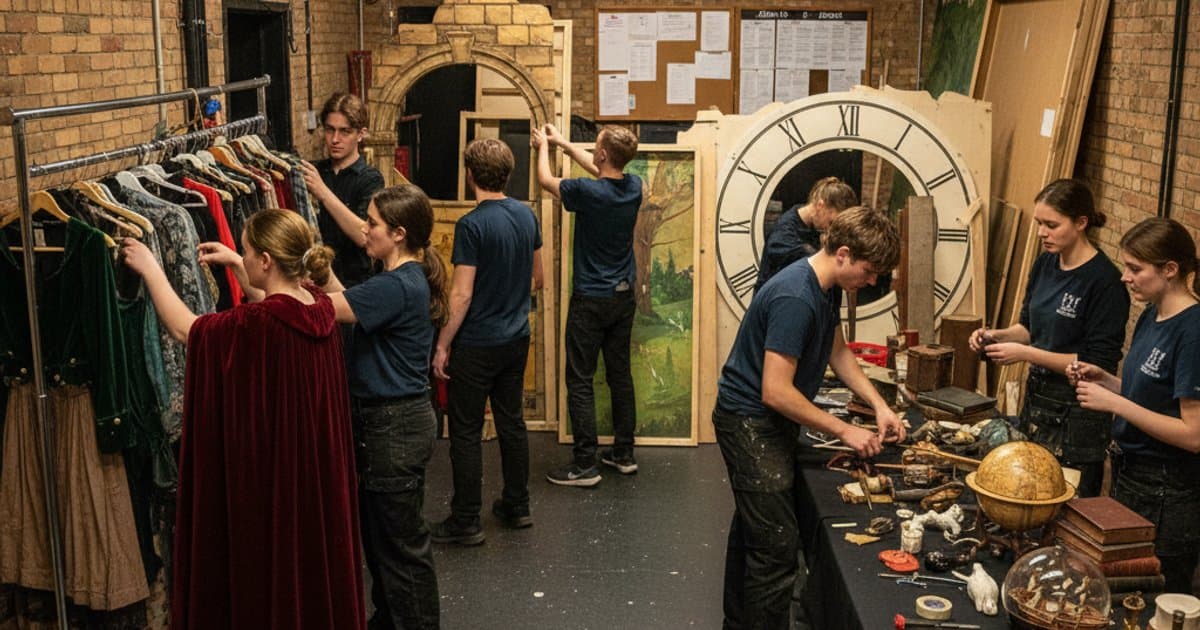
As soon as you have selected your production, go through the script scene by scene and create a comprehensive list of every prop, set piece, and piece of stage furniture required. For each item, note whether it is carried on by an actor, preset on stage, or brought on during a scene change. This document becomes your props bible and should be maintained by a dedicated props manager, even if that person is a parent volunteer.
Categorise each item as buy, borrow, make, or cut. Many drama schools accumulate enormous props stores over the years, so check your existing inventory first. For items you need to source, set a clear budget per item and a deadline for acquisition. Items that require construction need to be started at least six weeks before technical rehearsals.
Set Construction Practicalities
Unless you have access to a dedicated workshop space, set construction will likely happen in your rehearsal venue or a parent's garage. Consider the following before committing to elaborate sets:
- Transport: Can the set pieces physically fit through the venue doors? Measure before you build.
- Storage: Where will completed set pieces live between construction and get-in day?
- Safety: All set pieces must be structurally sound, flame-retardant (many venues require an FR certificate for scenic elements), and free of sharp edges or trip hazards.
- Scene changes: Design sets that can be changed quickly and quietly. Wheeled trucks, reversible flats, and modular pieces are your friends.
- Load-in and load-out: Allow a full day for get-in and at least half a day for strike. Brief your volunteer crew thoroughly on both.
The best drama school sets are not the most elaborate. They are the ones that serve the story, change efficiently, and do not collapse mid-show.
Licensing and Rights
Performing a published play or musical without the correct licence is illegal and can result in significant fines. This is non-negotiable, and the process needs to be started months before your performance dates.
Who Grants Performance Licences?
For musicals, the licence is typically granted by the rights holder's UK agent. The major ones are:
- Music Theatre International (MTI): Handles many Broadway and West End titles including junior and schools editions.
- Samuel French (now Concord Theatricals): Covers a huge catalogue of plays and musicals.
- Josef Weinberger: Represents several popular musical theatre titles in the UK.
- Nick Hern Books: Handles rights for many contemporary British plays.
Apply for your licence as soon as you confirm your show dates. Most agents require at least eight to twelve weeks' notice, and popular titles may have restrictions on concurrent local productions. You will need to provide your performance dates, venue capacity, ticket prices, and the number of performances. Licence fees for amateur and youth productions typically range from £80 to £500 per performance depending on the title and venue size.
Additional Music Licensing
If your production includes any music that is not part of the licensed show (for example, pre-show playlist music or interval background music), you will need a PRS for Music licence. Most venues hold their own PRS licence that covers events in the space, but check this with the venue manager rather than assuming.
Venue Licensing
The venue itself needs to hold a Premises Licence or Temporary Event Notice (TEN) that covers public entertainment. If you are performing in a school hall, church hall, or community centre, confirm with the venue that their existing licence covers theatrical performances with a paying audience. If it does not, you may need to apply for a TEN from your local council, which costs £21 and must be submitted at least ten working days before the event.
Programme Printing and Front-of-House
Your programme is a keepsake as much as an information document. Parents frame them, children treasure them, and they represent your drama school's brand to every audience member.
Programme Content
A good drama school programme should include:
- A welcome message from the principal or director
- Full cast list with headshots or group photos
- Production team credits (director, choreographer, musical director, stage manager)
- Scene and musical number breakdown
- Sponsor and supporter acknowledgements
- Information about your drama school's classes and upcoming events
- Biographies for principal cast members (particularly valued by older students)
Order programmes to cover approximately 70% of your expected audience, as not every attendee will take one. Digital programmes (a QR code linking to a PDF) are an increasingly popular complement to printed copies and cost nothing to distribute.
Front-of-House Operations
Front-of-house is the audience's entire experience from arrival to departure. Assign a front-of-house manager who is not involved in the backstage operation, so they can focus entirely on the audience. Their responsibilities include:
- Door management and ticket checking
- Programme distribution
- Seating assistance, particularly for accessible seating requirements
- Interval refreshments (a significant revenue opportunity, often raising £200 to £500 per show run)
- Emergency procedures briefing for all front-of-house volunteers
- Ensuring fire exits are clear and the venue capacity is not exceeded
Technical Crew and Production Week
For many drama schools, the technical side of a production is the area where they feel least confident. If you do not have in-house technical expertise, consider hiring a freelance technician for production week at minimum.
Lighting
Even a basic lighting rig transforms a performance. At minimum, you need front wash (general stage illumination), specials (individual spots for key moments), and a blackout capability. If the venue has a permanent rig, ask for a technical specification document. If you are bringing in equipment, budget £300 to £800 for a basic hire package including delivery and collection.
Sound
For musicals, sound is critical. Radio microphones for principal cast members, a sound desk, speakers, and fold-back monitors for the performers are the minimum. A basic radio microphone hire package (six to eight channels) costs approximately £400 to £1,000 for a production week. If your performers are young and inexperienced with microphones, schedule a dedicated sound check rehearsal before the first performance.
Stage Management
Your stage manager is the most important person in the building during production week. They call the cues, manage the backstage area, coordinate scene changes, and keep everything running to time. For youth productions, this role is often filled by an experienced parent or a drama school staff member. Give them authority and support.
The Production Week Schedule
A typical production week for a drama school runs as follows:
- Saturday/Sunday: Get-in, set construction on stage, lighting and sound rig
- Monday: Technical rehearsal (cue-to-cue, stopping for each lighting and sound cue)
- Tuesday: Full dress rehearsal
- Wednesday: Final dress rehearsal (treat as a performance)
- Thursday to Saturday: Performances
- Saturday night/Sunday morning: Strike (dismantling everything and returning the venue to its original state)
Key Takeaways
- Create a props bible and set construction plan at least eight weeks before production week.
- Apply for performance rights as early as possible. Budget £80 to £500 per performance for licensing fees.
- Confirm your venue's premises licence covers public entertainment with a paying audience.
- Appoint a dedicated front-of-house manager who is separate from the backstage team.
- If you lack in-house technical expertise, hire a freelance technician for production week.
- Build your production week schedule backwards from opening night and allow contingency time at every stage.
- Programmes, refreshments, and merchandise are revenue opportunities, not just costs.