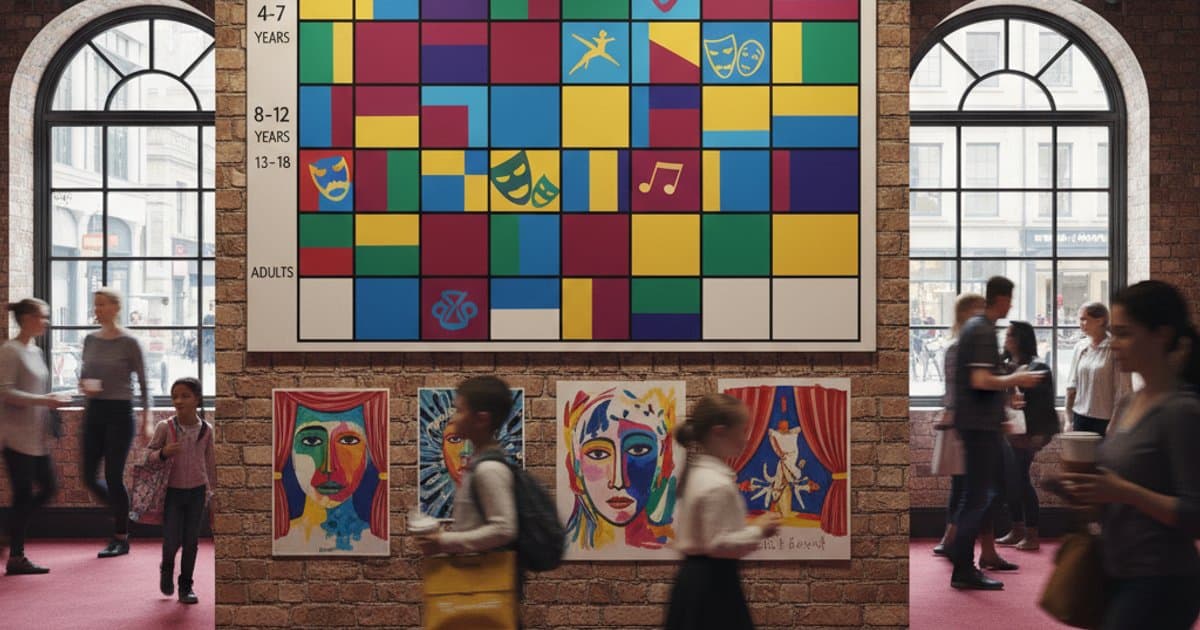
The Mixed-Age Challenge in Drama Education
Unlike swimming or gymnastics, where ability levels map fairly neatly to physical development, drama education often benefits from mixing ages. Older students mentor younger ones, ensemble work requires a range of ages for casting, and the collaborative nature of theatre thrives on diverse groups. However, this creates genuine safeguarding, logistical, and pedagogical challenges that need careful management.
Most drama schools run a combination of age-banded classes (under-7s, 7 to 11s, 12 to 16s, 16-plus) and mixed-age activities (productions, workshops, intensives). Getting this balance right is essential for both child safety and educational quality. A poorly managed mixed-age session can leave younger children overwhelmed and older students bored, while creating safeguarding risks that no amount of good teaching can compensate for.
Safeguarding in Mixed-Age Settings
Safeguarding is the primary concern when children of different ages share a space. The risks are different from single-age settings, and your policies need to reflect this explicitly.
Age-Appropriate Content
Drama involves exploring emotions, relationships, conflict, and sometimes difficult themes. Material that is perfectly appropriate for a 15-year-old may be entirely unsuitable for a 7-year-old sharing the same rehearsal room. You need a clear content rating system for all material used in mixed-age settings.
Consider adopting a simple framework:
- Universal (U): Suitable for all ages. No violence, romantic content, or distressing themes beyond what a young child could process.
- Guided (G): Suitable for ages 8 and above, or younger children with parental awareness. May include mild conflict, age-appropriate emotional content, or themes that benefit from discussion.
- Teen (T): Suitable for ages 12 and above only. May include more complex emotional themes, mild language, or topics requiring emotional maturity.
Every script, improvisation prompt, and workshop exercise used in a mixed-age session should be assessed against this framework before it enters the rehearsal room. Document your assessments and make them available to parents on request.
Physical Contact and Boundaries
Drama often involves physical contact: stage combat, dance lifts, emotional scenes requiring physical proximity. In mixed-age settings, you need clear rules about physical contact between participants of different ages. As a general principle, no physical contact between participants with an age gap of more than three years unless it is specifically choreographed, rehearsed under supervision, and approved by parents of all participants involved.
Changing and Facilities
If costume changes are required, children of different ages must have separate changing areas. Under no circumstances should under-12s share changing facilities with over-16s. Ideally, provide three separate areas: primary-age children, secondary-age children, and adults or over-18s. If the venue cannot support this, schedule staggered changing times and ensure adult supervision appropriate to each age group.
Staff Ratios for Mixed Groups
Standard staff ratios for drama activities are typically:
- Under-8s: 1 adult to 8 children
- 8 to 12s: 1 adult to 10 children
- 13 to 17s: 1 adult to 15 young people
In a mixed-age setting, apply the ratio for the youngest participants present. If you have a group of twenty containing six-year-olds and fifteen-year-olds, you need at least three DBS-checked adults regardless of how many older participants are present. Older students should never be counted as supervising adults, even if they are 17 and responsible.
Older students in your drama school are still children in the eyes of safeguarding law. They are participants, not staff, and must never be placed in a supervisory role over younger children.
Timetabling Strategies
Effective mixed-age timetabling requires thinking about both your regular weekly schedule and your production rehearsal calendar.
Weekly Class Structure
Most drama schools find that the following structure works well:
- Core age-banded classes: These are your bread-and-butter sessions where technique is taught in age-appropriate groups. Typically Saturday mornings or weekday after-school slots.
- Mixed-age ensemble sessions: One session per week or fortnight where the full company comes together. These focus on ensemble skills, production work, and collaborative exercises. Schedule these at a time when all age groups can attend, typically Saturday afternoons or Sunday mornings.
- Specialist workshops: Musical theatre, stage combat, audition technique, LAMDA preparation. These can be age-banded or ability-banded depending on the content.
Production Rehearsal Scheduling
This is where mixed-age timetabling becomes genuinely complex. A typical youth production involves cast members from age 6 to 18, but not every scene involves every age group. Scene-based scheduling is essential:
- Identify which cast members are needed for each scene and schedule rehearsals accordingly.
- Never require young children to wait for extended periods while older scenes are rehearsed. If a six-year-old's scenes are in acts one and three, do not make them sit through a two-hour act two rehearsal.
- Provide a separate supervised space for cast members who are waiting, with appropriate activities for their age group.
- Publish a detailed rehearsal schedule at least two weeks in advance so parents can plan drop-offs and pick-ups.
Buffer Time Between Sessions
When different age groups use the same space consecutively, build in at least fifteen minutes of buffer time. This prevents younger children arriving while older students are still in the space, allows the teaching team to reset the room, and avoids congestion in reception areas where parents are collecting and dropping off.
Parent Communication and Coordination
Parents of younger children in mixed-age settings need more information and reassurance than parents of older students. Your communication should address their concerns proactively.
Information to Provide
- Your content rating for the material being used
- The age range of participants in the session
- Staff ratios and the names of supervising adults
- Changing arrangements and supervision
- Exact drop-off and collection times (not just session times)
- Your policy on older participants interacting with younger ones
Consent and Commitment Forms
For production work that involves mixed-age rehearsals, issue a specific production commitment form that parents must sign. This should cover the rehearsal schedule, performance dates, costume requirements, and an acknowledgement that the production involves working alongside participants of different ages. This is not just good practice; it demonstrates that you have considered safeguarding at every stage and communicated transparently with families.
A management platform like AMES allows you to distribute and collect these forms digitally, track which families have and have not responded, and send automated reminders, removing the administrative burden of chasing paper forms through children's bags.
Key Takeaways
- Always apply staff ratios based on the youngest participants in a mixed-age session.
- Implement a content rating system for all material used in mixed-age settings and share it with parents.
- Provide separate changing facilities for different age groups without exception.
- Use scene-based scheduling for production rehearsals to avoid young children waiting unnecessarily.
- Build fifteen-minute buffer periods between consecutive sessions using the same space.
- Issue production-specific commitment forms that explicitly address the mixed-age nature of the work.
- Older students are never supervising adults, regardless of their maturity or trustworthiness.