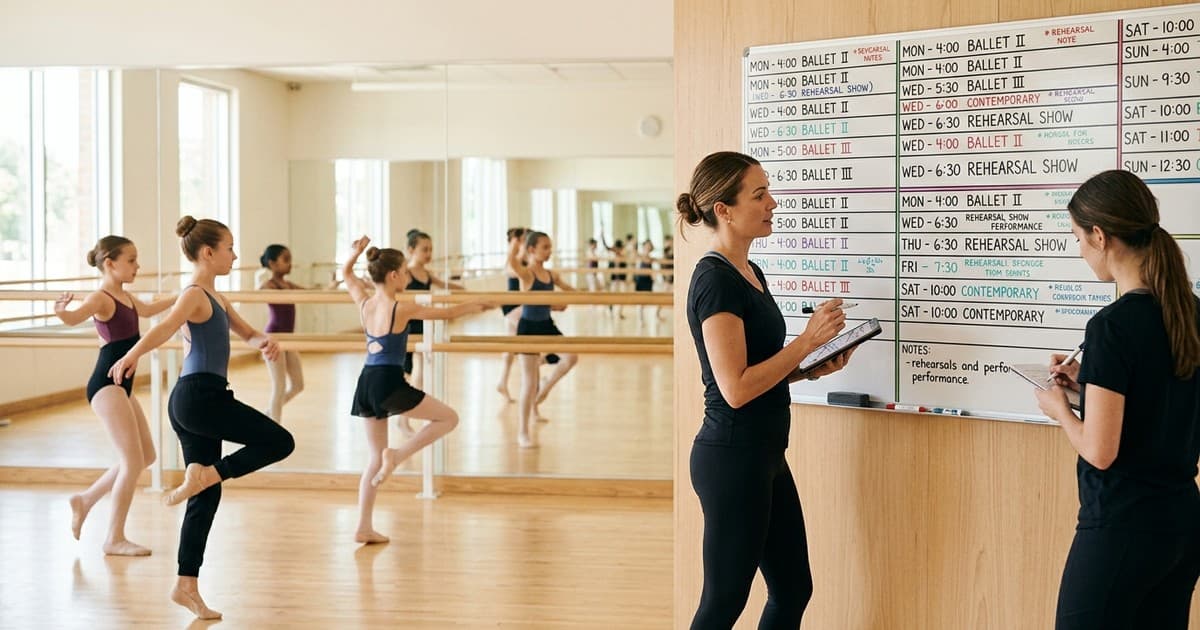
The Scheduling Challenge of Show Season
A dance school show involves more moving parts than most people realise. You are coordinating dozens of routines, hundreds of pupils, multiple rehearsal spaces, technical equipment, venue availability, and the schedules of teachers, volunteers, and families. Get the scheduling right and the show feels effortless. Get it wrong and you spend six weeks fielding panicked messages from parents who have been double-booked.
The difference between schools that run smooth shows and those that descend into chaos is almost always the quality of their scheduling. Not the quality of the dancing, not the size of the budget, but the rigour of the rehearsal plan and the clarity of communication around it.
This guide covers the practical mechanics of rehearsal and show scheduling, from the first planning meeting to the final curtain call.
Building Your Rehearsal Calendar
Working Backwards from Show Day
The most reliable way to build a rehearsal calendar is to start with your show dates and work backwards. If your show is in the last week of March, your dress rehearsal needs to be in the week before, your tech rehearsal the week before that, and your intensive rehearsal period needs to begin at least four weeks before the show. That means your regular-class rehearsal period, where routines are being taught and polished during normal lesson times, needs to start no later than January.
Map these phases onto a calendar and you immediately see how much time you actually have. Most principals find they have less time than they thought, which is exactly why this exercise is valuable. It forces you to prioritise and to cut routines that cannot realistically be ready in time.
Regular-Class Rehearsal Scheduling
During the regular-class phase, show routines are typically taught and rehearsed within existing lesson slots. The scheduling challenge here is managing pupils who appear in multiple routines. If a pupil is in both the Grade 3 ballet piece and the senior modern number, you need to ensure those classes are not being scheduled for run-throughs at times that conflict.
Create a pupil-routine matrix: a simple grid showing every pupil down the left side and every routine across the top. Mark which pupils appear in which routines. This matrix immediately reveals the conflicts you need to manage. AMES can generate these reports automatically from your class and cast data, which saves considerable time for larger schools.
Extra Rehearsals and Studio Time
Most shows require extra rehearsals beyond regular class time, particularly for group numbers, opening and closing sequences, and any routines that involve complex formations or props. Schedule these extra sessions as early as possible and communicate them to parents immediately. Parents with multiple children in the school or those who share pick-up duties need maximum notice to arrange logistics.
When booking additional studio time, check that your insurance covers extended hours and that your venue hire agreement permits the extra sessions. If you hire external rehearsal space, confirm the floor type (sprung or non-sprung), mirror availability, and sound system access before committing.
Tech and Dress Rehearsal Planning
The Tech Rehearsal
A tech rehearsal is not a dance rehearsal. It is a technical rehearsal for lighting, sound, staging, and transitions. Dancers need to be present, but the focus is on cues, not choreography. Your lighting designer needs to set levels and programme cues. Your sound operator needs to test every track at performance volume. Stage managers need to rehearse scene changes, prop placements, and wing clearances.
Schedule your tech rehearsal at the performance venue, allowing at least four hours for a standard show and a full day for a larger production. Run the show in order, stopping as needed for technical adjustments. Dancers should be in costume or close to it, because lighting levels are set based on costume colours and fabric reflectivity.
The Dress Rehearsal
Your dress rehearsal is a full run-through in costume, with lighting, sound, and all backstage logistics operating as they will on show night. This is your final opportunity to identify problems. Run it exactly as you would the real performance, including backstage calls, interval timing, and curtain calls.
After the dress rehearsal, hold a notes session with your teaching staff, stage manager, and backstage team. Identify anything that went wrong and assign responsibility for fixing it before the first performance. Keep notes brief and action-oriented: who needs to do what, by when.
Multi-Cast and Multi-Show Coordination
Managing Multiple Casts
Larger schools often run double or triple casts to give every pupil stage time without making the show excessively long. Multi-cast scheduling is where things get genuinely complicated. Each cast needs its own rehearsal time, its own costume allocation, and its own backstage schedule. Pupils who appear in both casts need particular attention to avoid burnout and scheduling conflicts.
The key principle is consistency within each cast. Each cast should rehearse together as a unit so that formations, spacing, and timing are consistent. Avoid the temptation to mix and match cast members between rehearsals, as this creates confusion and undermines the cohesion you are trying to build.
Scheduling Across Multiple Performances
If you are running shows on Friday evening, Saturday matinee, and Saturday evening, you need a clear schedule for which cast performs when, when each cast arrives for warm-up, when backstage areas are accessible, and when the venue is available for resets between shows. Build this into a single master timeline document that every member of your team can access.
Backstage Scheduling and Volunteer Coordination
Backstage Roles and Responsibilities
A well-run backstage requires clearly defined roles: a stage manager who controls the running order and calls cues, wing marshals who manage dancers entering and exiting, costume helpers who assist with quick changes, and chaperones who supervise younger dancers when they are not on stage. For shows involving children under sixteen, you have a legal requirement under the Children (Performances and Activities) (England) Regulations 2014 to provide adequate supervision backstage.
Each role needs a named person for each performance. Create a backstage rota and distribute it at least two weeks before the show. Brief all volunteers in person, ideally at the dress rehearsal, covering fire exits, first aid, safeguarding contacts, and their specific responsibilities.
Parent Communication During Show Season
Parents need clear, timely information about rehearsal schedules, costume requirements, arrival times, backstage access rules, photography policies, and ticket arrangements. The most effective approach is a single show information pack issued at the start of show season, followed by weekly updates as the show approaches.
Use a consistent communication channel. If you normally communicate through AMES, keep show communications there too. Parents who are juggling information across email, WhatsApp groups, paper letters, and a parent portal will inevitably miss something. One channel, used consistently, reduces confusion and the volume of queries you need to field.
Key Takeaways
- Work backwards from your show date to build a rehearsal calendar that accounts for regular-class rehearsals, extra sessions, tech, and dress rehearsals.
- Create a pupil-routine matrix to identify scheduling conflicts for dancers who appear in multiple numbers.
- Schedule extra rehearsals as early as possible and communicate dates to parents immediately.
- Use your tech rehearsal for technical cues and lighting, not for polishing choreography.
- Run your dress rehearsal exactly as the real performance, then hold a focused notes session afterwards.
- Keep multi-cast rehearsals separate so each cast builds its own cohesion and timing.
- Define all backstage roles clearly, create a rota, and brief volunteers at the dress rehearsal.
- Issue a single show information pack and provide weekly updates through one consistent communication channel.