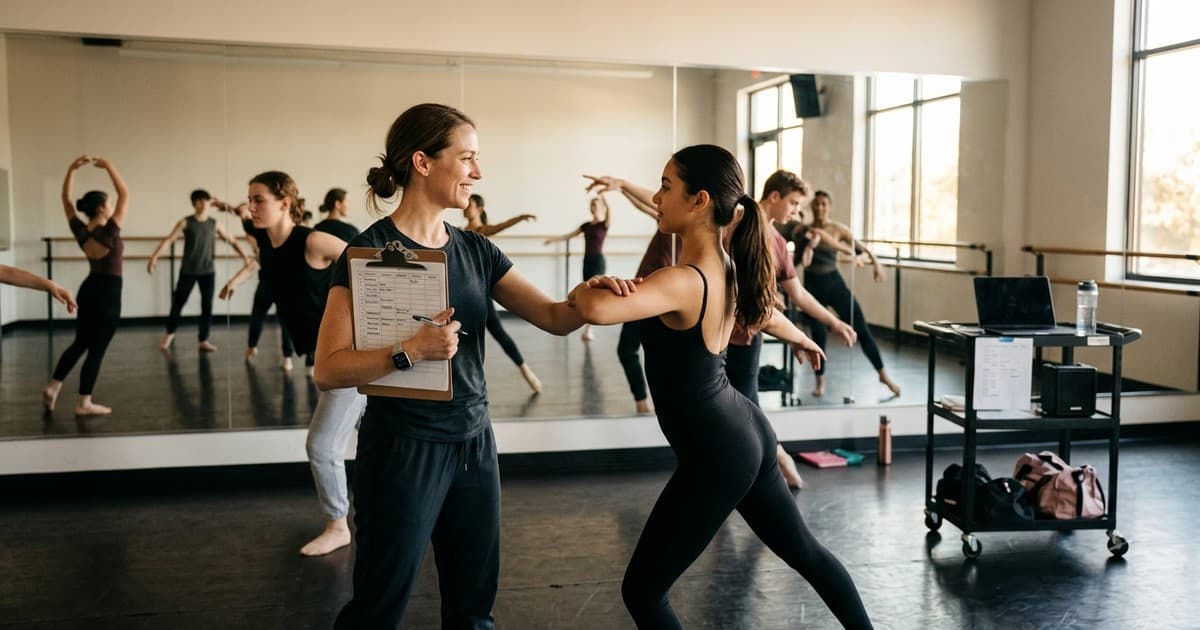
Teachers Make or Break Your Dance School
A dance school is only as good as its teachers. Parents choose your school because of the quality of instruction their children receive, and they leave when that quality drops. But managing a team of dance teachers is not like managing employees in most other businesses. Dance teachers are often self-employed, may work across multiple schools, have qualifications that span different examination boards and disciplines, and expect pay rates that reflect the specialism and level of each class they teach.
On top of this, you need to track their DBS checks, teaching qualifications, first aid certificates, insurance, and continuing professional development. You need to arrange cover when they are ill or on holiday. And you need to pay them accurately, on time, with clear documentation of what each payment covers.
This guide covers the systems and practices you need to manage your teaching team effectively, keeping them happy, compliant, and delivering the quality that your families expect.
Qualification Tracking and Compliance
What You Need to Track
Every dance teacher working in your school needs a set of essential documents and qualifications. At minimum, you should track:
- Enhanced DBS check with children's barred list: required for anyone in regulated activity with children. Record the certificate number, issue date, and whether they are registered with the DBS Update Service.
- Teaching qualifications: the specific qualifications from RAD, ISTD, IDTA, or other bodies that authorise them to teach particular disciplines at particular levels. A teacher with an ISTD teaching diploma in Modern Theatre Dance is qualified to enter pupils for ISTD modern exams but not necessarily for ISTD ballet exams.
- First aid certificate: at least one member of staff on site should hold a current paediatric first aid certificate. Many schools require all teachers to have one.
- Public liability insurance: self-employed teachers should carry their own insurance. Employed teachers are typically covered by the school's policy, but confirm this with your insurer.
- Safeguarding training: all staff working with children should complete safeguarding awareness training and refresh it regularly.
For each document, record the qualification name, the issuing body, the date obtained, the expiry date (if applicable), and whether you hold a copy on file. Set up automated expiry reminders so you are alerted thirty days, fourteen days, and seven days before any document expires. A teacher whose DBS check has expired cannot teach until it is renewed, and discovering this on the day they are due to take a class is a safeguarding failure, not just an administrative inconvenience.
Discipline Specialisms
Dance teaching qualifications are discipline-specific. A teacher might hold RAD CBTS (Certificate in Ballet Teaching Studies) for classical ballet, an ISTD Associate diploma in Tap, and no formal qualification in street dance despite being an excellent street dancer. Your system needs to map each teacher's qualified disciplines clearly so that you only assign them to classes they are formally qualified to teach.
This is particularly important for exam classes. RAD, ISTD, and IDTA all require that candidates are entered by a teacher who holds the appropriate qualification from that board. If an unqualified teacher enters pupils for an exam, the entries may be rejected. Map qualifications to disciplines in your management system and use this data when building your timetable to ensure every class is taught by an appropriately qualified instructor.
Holiday Cover and Absence Management
Building a Cover System
When a teacher is absent, you need a qualified replacement who can step in at short notice and deliver the class to an acceptable standard. This requires a cover pool: a list of available cover teachers with their qualifications, availability, contact details, and the rates they charge. Build this pool before you need it. Recruiting cover teachers in a panic on the morning of a class is stressful, unreliable, and often unsuccessful.
Your cover pool should include teachers who are qualified in the same disciplines as your regular staff. If your ballet teacher calls in sick, you need a cover teacher with ballet qualifications, not a street dance specialist. Match cover teachers to disciplines in your system so that when you search for available cover, the results are filtered to show only qualified options.
Holiday Planning
Require teachers to submit holiday requests at least four weeks in advance, and preferably at the start of term. This gives you time to arrange cover and to communicate any changes to parents. If two teachers request the same week off and you cannot cover both absences, you need a policy for who gets priority. First-come-first-served is the simplest approach, but some schools give priority to teachers who have not taken time off recently.
During school holiday periods (half term, Easter, summer), decide in advance whether you are running classes. If you are, confirm teacher availability early. If you are not, communicate the closure dates to parents at the start of term so they can plan childcare.
Pay Rate Management
Pay Rates by Discipline and Level
Dance teachers typically expect different pay rates depending on the discipline, the level, and the type of class. A vocational-level RAD ballet class requires more expertise and preparation than a recreational pre-school dance class, and the pay should reflect that. Common pay structures include:
- Hourly rate by discipline: a flat rate per teaching hour that varies by discipline (ballet might pay more than street dance due to qualification requirements).
- Hourly rate by level: a rate that increases with the level taught (pre-primary pays less than Grade 5, which pays less than vocational).
- Per-class rate: a fixed fee per class regardless of duration, which simplifies calculations but can feel unfair for longer classes.
- Revenue share: a percentage of the class fees collected, which aligns the teacher's income with class size but creates income uncertainty.
Whatever structure you use, document it clearly in writing. Each teacher should know their rate for every class they teach, how it is calculated, and when they will be paid. Ambiguity about pay is one of the fastest ways to lose a good teacher.
Handling Additional Duties
Teachers often perform duties beyond regular class teaching: choreographing for shows, attending rehearsals, running exam preparation sessions, covering for colleagues, and attending professional development. Establish clear rates or agreements for each of these. Show rehearsal time is a particularly common source of tension if it is expected but not compensated. Be explicit about whether rehearsal time is included in the teaching rate or paid separately.
Timesheet Generation and Payroll
Accurate Timesheet Systems
Generating accurate timesheets for a team of dance teachers who each teach different classes at different rates is a significant administrative task. If a teacher teaches six classes per week at three different rates, their weekly pay calculation involves six separate line items. Multiply that by ten teachers and a monthly pay run becomes a complex exercise.
Use your management system to generate timesheets automatically from the timetable data. If the system knows which classes each teacher taught, the duration of each class, and the agreed rate, it can calculate the gross pay without manual intervention. Teachers should be able to review their timesheets before payment and flag any discrepancies.
Self-Employed vs. Employed Teachers
The employment status of your teachers has significant implications for pay, tax, and rights. HMRC's IR35 rules and the employment status tests determine whether a teacher is genuinely self-employed or should be treated as an employee. Key factors include whether the teacher can send a substitute, whether they work for other schools, whether they set their own hours, and whether they provide their own equipment. Get this wrong and you face potential tax liabilities and penalties.
If your teachers are self-employed, they invoice you and manage their own tax and National Insurance. If they are employed, you must operate PAYE, provide employment contracts, and comply with employment legislation including holiday pay, sick pay, and pension auto-enrolment. Seek professional advice from an accountant familiar with the performing arts sector if you are unsure about anyone's status.
Key Takeaways
- Track every teacher's DBS check, teaching qualifications, first aid certificate, insurance, and safeguarding training with automated expiry reminders.
- Map each teacher's qualified disciplines and examination board registrations to ensure only qualified staff teach exam classes.
- Build a cover pool of available teachers matched by discipline so you can arrange qualified cover at short notice.
- Require holiday requests at least four weeks in advance and communicate any class changes to parents promptly.
- Document pay rates clearly for each discipline, level, and additional duty so there is no ambiguity about compensation.
- Generate timesheets automatically from timetable data to eliminate manual calculation errors and save administrative time.
- Ensure the employment status of every teacher is correctly determined under HMRC rules to avoid tax liabilities.
- Treat your teachers as your most valuable asset: clear systems, fair pay, and professional development keep good teachers loyal.