The Challenge of Multi-Event Sessions
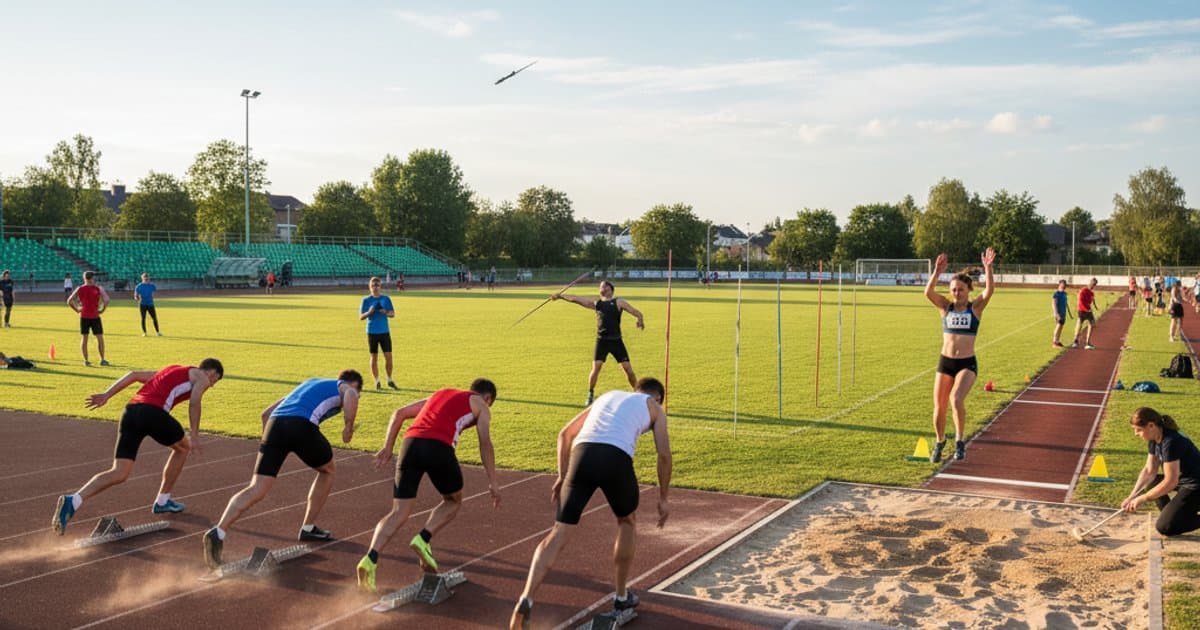
Athletics is unique among sports because a single training session might involve sprinters on the track, throwers in the field, jumpers at the pit, and endurance runners on the infield or surrounding paths. Coordinating all of this safely within a two-hour window is one of the hardest operational challenges an athletics club faces.
Most clubs operate from shared facilities, often local authority tracks managed under an England Athletics RunTogether or Club Connect agreement. You rarely have exclusive access, which means your session planning must account for other users, restricted areas, and the reality that equipment cannot be left set up between sessions.
The clubs that do this well have a system. They plan rotations in advance, assign coaches to zones rather than groups wandering freely, and build their timetable around facility constraints rather than fighting against them. This guide sets out how to build that system from scratch.
Mapping Your Facility Into Zones
Before you plan any session, you need a zone map. Walk your facility and define distinct areas where different event groups can operate simultaneously without interference. A standard eight-lane track with infield typically offers four to six usable zones.
Track Zones
The main track can be split into sprint and endurance zones. Sprinters typically need lanes one to four for repetitions up to 200 metres, while endurance athletes use the outer lanes or the full circuit. If you are running both simultaneously, establish a rule that sprinters work in one direction only and endurance runners stay in lanes six to eight. Brief every athlete on this at the start of every session.
Field Zones
Throws areas require the most careful management because of the safety exclusion zones mandated by England Athletics. A discus cage has a sector of approximately 34.92 degrees, and the landing area must be completely clear during throwing. Shot put circles need a smaller exclusion zone but still demand line-of-sight supervision. Javelin requires a runway and a landing sector that overlaps with much of the infield, which often means javelin can only be scheduled when the infield is otherwise clear.
Jumps areas are typically fixed in position: long jump and triple jump pits, high jump fans, and pole vault boxes. These are lower risk than throws but still require dedicated coaching supervision. A common mistake is leaving the high jump area unsupervised because the bar is 'only' at a low height. The injury risk from poor landing technique exists at every height.
Ancillary Zones
Warm-up areas, stretching zones, and plyometric stations can be set up on grass areas adjacent to the track. These are useful as holding zones in your rotation, giving groups purposeful activity while they wait for their turn in a primary zone.
Designing the Rotation Schedule
Once your zones are mapped, build a rotation matrix. The simplest effective model is a three-station rotation with equal time blocks.
Time Block Structure
A two-hour session (the standard for most England Athletics affiliated clubs) works well as follows: 15 minutes for warm-up and briefing, three rotation blocks of 25 to 30 minutes each, and 10 to 15 minutes for cool-down and debrief. This gives each group meaningful time in each zone without sessions dragging or athletes standing idle.
Equipment Changeover
Build five minutes of changeover time into each rotation. Throws equipment needs to be collected and returned to marked positions. Jump pit sand needs raking. Hurdles need adjusting for different age groups. If you schedule back-to-back rotations with no buffer, you lose more time to chaotic transitions than you save by scheduling tightly.
Coach Assignment
Assign coaches to zones, not to groups. This is a critical principle. When coaches follow their group between zones, there is always a period where a zone is either unstaffed or double-staffed. If Coach A is responsible for the throws zone all evening, that zone is always supervised, equipment is always managed consistently, and the coach can adapt drills to each group's ability level as they rotate through.
For this model to work, you need a minimum of one qualified coach per active zone, plus one floating coach or session coordinator who manages transitions and handles any issues. England Athletics recommends coach-to-athlete ratios of 1:12 for under-11s and 1:20 for older age groups, but these are maximums. For throws supervision, 1:8 is safer and more effective.
Equipment Allocation and Tracking
Athletics equipment is expensive and easily damaged when poorly managed. A discus set costs upward of 300 pounds, javelins over 100 pounds each, and a full set of hurdles over 1,000 pounds. Track your equipment with a simple inventory system.
Pre-Session Equipment Checks
Before every session, the zone coach should verify that their equipment is present and in safe condition. Javelin tips must be intact, shot puts must not be cracked, discus rims must be smooth, and hurdle mechanisms must lock correctly. Build a two-minute equipment check into the start of every session and record it. This protects athletes and protects your club in the event of an insurance claim.
Age-Appropriate Equipment
England Athletics specifies implement weights by age group. Under-13 boys throw a 3.25 kg shot, while under-15 boys throw 4 kg, and under-17 boys throw 5 kg. Getting this wrong is both a safety issue and a competition standards issue, because athletes training with the wrong weight develop poor technique. Label your equipment clearly by weight and store it in age-group sets so coaches can grab the right kit quickly.
Storage and Security
If you share a facility, your equipment storage needs to be lockable. Agree storage arrangements with the facility manager in writing. Lost or damaged club equipment is one of the most common unbudgeted costs for athletics clubs, and it is almost always preventable with proper storage and a sign-in/sign-out log.
Safety and Risk Management
Multi-event sessions carry higher risk than single-discipline training because of the number of simultaneous activities, particularly throws. Your risk assessment must be reviewed at least annually and updated whenever you change your rotation or facility layout.
Throws Safety Protocols
England Athletics publishes detailed throws safety guidance. The key requirements are: a designated throws area with clear boundaries, a verbal call-and-response system before every throw ('Clear to throw?' followed by 'Clear!'), no retrieval of implements until all throwers have completed their set, and a qualified coach supervising at all times. Implement these protocols without exception. A discus or javelin striking a bystander can cause life-changing injury.
Wet Weather Procedures
Rain changes everything. Throws become more dangerous because implements are slippery, the shot put circle and discus ring lose grip, and javelin run-ups become treacherous. Have a wet weather plan that either moves throws indoors (if you have space) or substitutes them with technique drills using lighter training implements. Similarly, long jump and triple jump should be suspended if the runway is waterlogged, as the slip risk on the takeoff board is significant.
Emergency Procedures
Every coach should know the location of the nearest first aid kit and defibrillator, the facility's emergency action plan, and how to contact emergency services with the venue's exact address and postcode. For a multi-zone session, establish a communication method between zone coaches, whether that is a whistle signal, walkie-talkies, or a group messaging app.
The best session plan means nothing if a throws implement lands in an unsecured zone. Safety zoning is the foundation of multi-event session planning, and it must be checked every single session.
Key Takeaways
- Map your facility into defined zones before planning any rotation schedule, accounting for throws exclusion areas and shared-use constraints.
- Use three rotation blocks of 25 to 30 minutes with five-minute changeover buffers to keep sessions flowing without dead time.
- Assign coaches to zones rather than groups so every area has consistent supervision and equipment management throughout the session.
- Track equipment with pre-session checks and age-group labelling, and secure lockable storage if you share a facility.
- Review your risk assessment annually and enforce throws safety protocols at every single session without exception.