The Opportunity in Children's Music Education
Music education in UK state schools has been in decline for over a decade. Budget cuts have reduced the number of peripatetic music teachers, and many primary schools now offer minimal or no instrumental tuition. According to the Musicians' Union, the number of children receiving music tuition in school fell by over 20% between 2016 and 2023.
This creates a significant and growing market for private music education. Parents who value music recognise that it develops discipline, concentration, creativity, and academic achievement. The correlation between music education and improved academic outcomes is well documented, and parents are willing to invest in structured, professional provision that delivers measurable progress.
A children's music school can take many forms: one-to-one instrumental lessons, group tuition, early-years music classes, ensemble and band programmes, or a combination of all of these. The model you choose will depend on your qualifications, your local market, and your available space.

Qualifications and Examining Bodies
Music teaching in the UK does not have a single mandatory qualification, but the examination boards set the standards that parents expect and recognise.
ABRSM (Associated Board of the Royal Schools of Music)
The most widely recognised examining body in the UK and internationally. ABRSM offers graded examinations from Initial Grade through Grade 8, plus diplomas (DipABRSM, LRSM, FRSM) for advanced musicians. ABRSM exams are available for virtually every orchestral instrument, piano, singing, and music theory.
To enter students for ABRSM exams, you do not need to be formally registered with them, but having ABRSM qualifications yourself or equivalent is expected by parents. A DipABRSM in Music Teaching or a music degree with a teaching focus is the standard benchmark.
Trinity College London
Trinity offers graded exams, diplomas, and the increasingly popular Rock and Pop syllabus for guitar, bass, drums, and vocals. This syllabus appeals to children who are more interested in contemporary music than classical repertoire, and it has become a significant growth area for music schools.
RSL Awards (Rockschool)
Specialist in rock, pop, and contemporary music across guitar, bass, drums, keys, and vocals. Increasingly popular with younger students influenced by contemporary music culture. Graded from Debut through Grade 8 with UCAS tariff points at higher levels.
London College of Music (LCM)
Part of the University of West London, LCM offers graded and diploma examinations with a slightly different repertoire emphasis. Less well-known than ABRSM and Trinity but equally valid as a qualification pathway.
Structuring Your Music School
One-to-One Tuition
The traditional model for instrumental and vocal lessons. Typically 30-minute lessons for beginners, progressing to 45 or 60 minutes for more advanced students. Thirty minutes is the sweet spot for concentration in children under 10.
Pricing: GBP 20-40 per 30-minute lesson is typical outside London; GBP 30-55 in London. Pricing depends on the instrument, the teacher's qualifications, and the local market.
Advantages: High revenue per hour. Personalised teaching. Fastest student progress.
Challenges: Revenue is capped by the number of teaching hours available. Cancellations have a larger financial impact because the entire slot revenue is lost.
Small Group Tuition
Groups of 2-4 students learning the same instrument at the same level. This works particularly well for guitar, ukulele, recorder, and early-stage piano.
Pricing: Typically 50-70% of the one-to-one rate per student, but you earn more per teaching hour overall.
Advantages: Higher revenue per hour. Social element motivates younger students. More accessible price point for families.
Challenges: Requires students at matching levels. Instrument availability if you need to provide instruments in class.
Early Years Music Classes
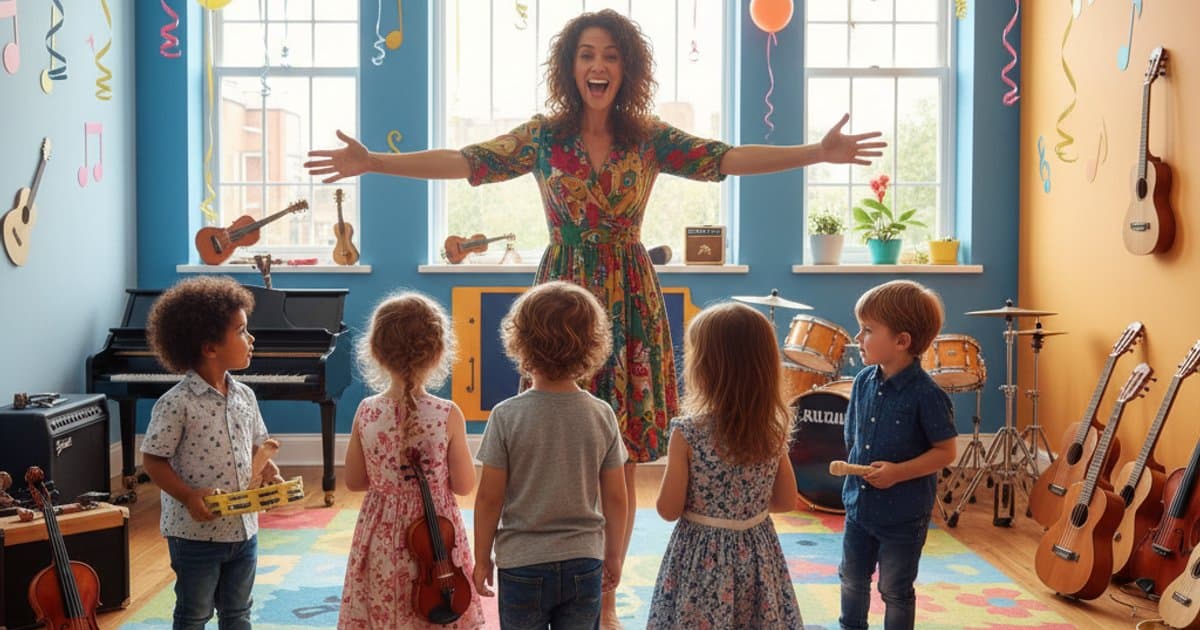
Group classes for babies and toddlers (typically 0-4 years) using singing, movement, rhythm instruments, and sensory play. This is a high-demand, high-margin segment that feeds directly into your instrumental programme.
Pricing: GBP 6-12 per session for groups of 10-15 with a parent present.
Advantages: Large groups, high demand, low equipment cost, builds a pipeline of future instrumental students as children grow older.
Ensemble and Band Programmes
Once students reach approximately Grade 3-4 standard, offering ensemble opportunities such as orchestras, bands, and choirs adds enormous value. Ensemble experience is a key differentiator for a music school and one of your most powerful retention tools. Students who play in ensembles develop sight-reading, listening skills, and a sense of musical community that keeps them enrolled for years.
Instrument Provision and Management
Unlike most other activities, music requires each student to have an instrument. This creates both a challenge and an opportunity for your business.
- Parents purchase: Recommend trusted retailers and provide guidance on appropriate instruments for beginners. Warn against the cheapest options: a GBP 30 violin from an online marketplace will frustrate teacher and student alike. Build relationships with local music shops who may offer discounts to your students.
- Instrument hire schemes: Offer instruments for rent at GBP 10-20 per month. This removes the upfront barrier for families and generates recurring revenue. Some music schools build libraries of quality student instruments over time, creating a valuable business asset.
- Provided for lessons: For group classes, especially piano, drums, and early-years percussion, provide instruments on-site so students do not need to transport them. This is essential for piano and drum lessons where the instrument cannot practically travel.
Venue and Acoustic Considerations
Music has specific venue needs that are often underestimated by new school owners:
- Soundproofing: Multiple lessons happening simultaneously require adequate sound insulation between rooms. This is the single biggest venue challenge for music schools. Without it, a trumpet lesson bleeds into a violin lesson and both suffer.
- Room size: One-to-one rooms can be small (8-12 square metres) but must not feel claustrophobic. Group rooms need 20-40+ square metres depending on ensemble size.
- Acoustics: Hard, reflective surfaces make small rooms unpleasant for loud instruments. Acoustic panels (GBP 200-500 per room) or even heavy curtains and soft furnishings help significantly.
- Waiting area: Essential. Parents bring siblings, wait during lessons, and this is where your community atmosphere develops. A welcoming reception area with seating, a noticeboard of achievements, and perhaps a small retail display of books and accessories makes a strong impression.
- Piano access: If you teach piano, you need reliable instruments in each teaching room. Digital pianos with weighted keys (GBP 500-1,500) are a practical alternative to acoustic uprights for teaching studios, and they allow headphone use for shared spaces.
Building Your Curriculum and Concert Calendar
While the graded examination system provides a framework, your teaching approach and performance culture are what differentiate your school from individual private tutors:
- Balance exam preparation with musicianship: Students who only prepare exam pieces become technically proficient but may not develop a love of music. Include improvisation, composition, and playing for fun alongside exam work.
- Theory integration: ABRSM requires Grade 5 Theory before entering Grade 6 practical. Integrate theory into lessons from the start rather than treating it as a separate hurdle that catches students off guard at Grade 5.
- Performance opportunities: Regular recitals and informal concerts build confidence and give families a sense of community and progress. Plan your first recital within six months of launching. Even beginners can perform a short piece, and the pride on parents' faces is your best marketing material.
- Digital tools: Practice-tracking features in platforms like AMES help students practise effectively between lessons and give parents visibility of their child's engagement. Teachers can assign practice tasks and parents can see what was covered in each lesson.
Actionable Takeaways
- Decide your core offering: Will you focus on one-to-one tuition, group classes, early years, or a combination? Your venue and staffing needs depend entirely on this decision.
- Register with at least one examining body (ABRSM and/or Trinity) and familiarise yourself with their current syllabi and examination schedules well before you need to enter students.
- Consider starting with a hire scheme for at least one instrument. Removing the instrument purchase barrier significantly increases enrolment for beginners.
- Plan your first recital within six months of launching. Performance is the heartbeat of a music school, and it starts from day one.