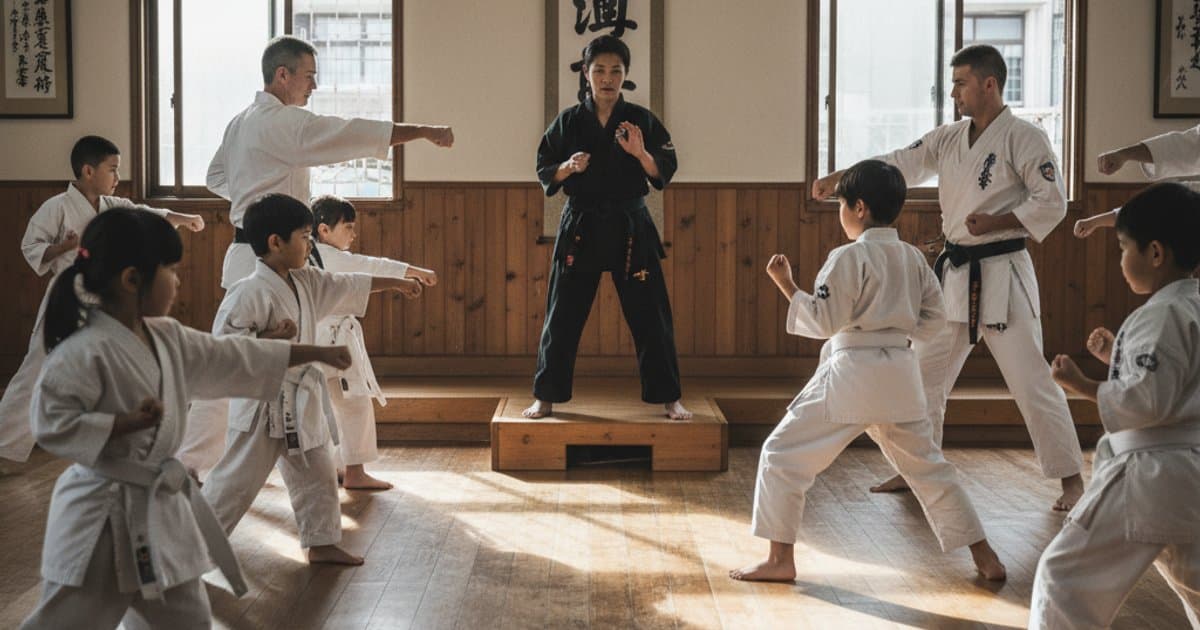
The Reality of Mixed-Rank Training
Unless your school has hundreds of students and a large timetable, you will run mixed-rank classes. A typical karate class might include students from white belt (9th kyu) through to brown belt (1st kyu), spanning a huge range of experience and ability. A judo session might mix yellow belt (5th kyu) players with those preparing for their green belt (3rd kyu) examination. In BJJ, white belts regularly train alongside blue and purple belts.
Mixed-rank classes are not inherently problematic. In fact, they offer genuine benefits: junior students learn by watching senior grades, senior students reinforce their fundamentals by helping beginners, and the class develops a sense of community across experience levels. The problems arise only when the instructor fails to plan for the mixed ability range, resulting in beginners feeling overwhelmed, advanced students feeling unchallenged, or safety being compromised during partner work.
This guide provides practical strategies for making mixed-rank classes productive and safe for everyone on the mat.
Partner Pairing: The Foundation of Safe Mixed-Rank Training
Partner work is where mixed-rank classes require the most careful management. The wrong pairing can result in injury, frustration, or both.
Pairing Principles
- Size and weight matching: For any contact work, pair students of similar size. This is more important than grade matching, particularly in grappling arts like judo and BJJ where a significant weight difference creates genuine injury risk. The BJA recommends weight categories for randori (free practice) in junior sessions: under 30kg, 30-40kg, 40-50kg, and so on.
- Grade-appropriate pairing for technique practice: When drilling specific techniques, pairing a senior student with a junior student works well. The senior student provides a controlled, cooperative partner while reinforcing their own technique through teaching. This is a time-honoured approach in Japanese martial arts, known as sempai-kohai (senior-junior) training.
- Rotate partners regularly: Students who always train with the same partner develop habits specific to that partner's body type and reactions. Rotate every 3 to 5 minutes during drilling to expose students to different body types and responses.
- Instructor-assigned pairing: Do not allow students to choose their own partners in mixed-rank classes. Self-selection leads to friends pairing up regardless of suitability, and newer students being left without partners. Assign pairs deliberately based on the activity.
Sparring Considerations
Free sparring (kumite in karate, randori in judo, rolling in BJJ) requires the most careful management in mixed-rank classes. Key rules to enforce:
- Senior grades must control their intensity: Make this an explicit expectation, not an assumption. A brown belt sparring with a yellow belt should be working on timing and precision, not power.
- Set specific objectives: Rather than open sparring, give each pair a specific focus. The senior student might work only on counter-attacks while the junior student practises their basic combinations.
- Separate weight categories for full-contact work: In any class involving significant contact, such as taekwondo sparring with body protectors, separate students by weight. A 70kg adult sparring with a 45kg teenager is unacceptable regardless of grade.
- Use timed rounds with breaks: Short rounds of 90 seconds to 2 minutes with 30-second breaks allow you to reassess pairings and give corrections.
Split-Group Activities: Teaching Multiple Levels Simultaneously
The most effective approach to mixed-rank classes is to split the class into groups for parts of the session, allowing you to teach grade-appropriate content to each group.
Session Structure for Mixed-Rank Classes
A well-structured mixed-rank session typically follows this pattern:
- Warm-up (10 to 15 minutes): The whole class trains together. Basic exercises, stretching, and fundamental movements that are appropriate for all levels.
- Fundamentals (10 minutes): Basic techniques practised by the whole class. Even advanced students benefit from repetition of fundamentals. In karate, this might be basic oi-zuki (stepping punch) and gedan-barai (downward block) combinations. In judo, basic breakfalls and movement drills.
- Split session (15 to 20 minutes): Divide the class by grade range. Beginners work on their current syllabus requirements with an assistant instructor or senior student leading, while advanced students work on more complex techniques, kata, or sparring drills with the head instructor.
- Partner work (10 to 15 minutes): Bring the class back together for paired drilling or controlled sparring, using the pairing principles above.
- Cool-down and line-up (5 minutes): Whole class together for stretching, any announcements, and the formal class closing.
Using Senior Students as Teaching Assistants
In many traditional martial arts schools, senior students are expected to help teach as part of their own development. This is particularly true in karate, where the ability to teach is considered part of the dan grade journey. Assign specific senior students to lead beginner groups during the split session. Brief them before class on what you want covered. This develops their leadership skills while freeing you to work with students who need the most technical input.
A brown belt who can clearly explain and demonstrate a technique to a white belt is demonstrating a deeper understanding than one who can only perform it. Use mixed-rank classes as a development opportunity for your senior students.
Safety Protocols for Mixed-Rank Environments
Safety in mixed-rank classes requires explicit protocols that go beyond what you might need in a single-grade class.
Essential Safety Measures
- Clear rules on contact levels: Define what contact is permitted for each activity. In karate, this might be no contact for beginners in kumite, light contact (touch only) for intermediate students, and controlled contact for advanced students. Display these rules visibly and reinforce them at the start of every session.
- Equipment requirements by grade: Mandate appropriate protective equipment. Gum shields, groin guards, and shin pads should be required for any contact sparring. In taekwondo, body protectors (hogu) are essential for sparring. Specify minimum equipment by activity, not by grade.
- Incident reporting: Maintain a formal incident log for any injury, however minor. Record the activity, the students involved, the nature of the injury, and any first aid provided. This is both good practice and essential for your insurance.
- Instructor positioning: During split sessions, position yourself where you can observe both groups. During sparring, actively move around the mat rather than watching from one position.
Key Takeaways
- Pair students deliberately: Match by size and weight for contact work, and by grade for cooperative technique drilling. Never allow self-selection in mixed-rank classes.
- Structure sessions with a split-group segment to deliver grade-appropriate content while maintaining whole-class activities for warm-up, fundamentals, and cool-down.
- Set explicit contact rules per activity and enforce them consistently. Senior grades must control intensity when working with junior students.
- Use senior students as teaching assistants during split sessions to develop their leadership skills and free you to focus on technical coaching.
- Separate weight categories for any significant contact work, following governing body guidelines such as those from the BJA for judo.
- Rotate partners every 3 to 5 minutes to expose students to different training experiences and prevent habitual pairing.