Why Progression Systems Drive Retention
The single biggest reason families leave a gymnastics club is the feeling that their child is not making progress. Not that the child is actually failing to progress, but that the progress is not visible. Children improve week by week in small increments. A coach sees it because they watch every session. A parent sitting in the viewing gallery once a week may not notice the improvements at all. Without a structured progression system that makes progress visible, parents reach a point where they question the value of continued attendance.
British Gymnastics understands this, which is why the BG Proficiency Award Scheme exists. But the official scheme, while excellent as a framework, is not enough on its own. The gap between consecutive BG badges can represent months of training, and during those months parents need to see progress being made. Your club's progression system needs to fill those gaps with intermediate milestones, visual indicators, and regular recognition moments.
This guide covers how to design, implement, and manage a comprehensive badge and award progression system that keeps gymnasts motivated and parents engaged for years.
Designing Visual Progression Charts
A visual progression chart is the single most effective tool for communicating progress to gymnasts and parents. It transforms an abstract list of skills into a concrete, visual journey.
Wall Charts in the Gym
Mount a large-format progression chart in the viewing area where parents can see it. The chart should show every level in your programme from beginner to advanced, with the specific skills required at each level clearly listed. Use colour coding to match your group names (for example, red for beginners, blue for intermediate, green for advanced). When a gymnast earns a badge or achieves a milestone, their name or photo goes on the chart. This creates public recognition, healthy motivation, and gives parents a visual answer to "how is my child doing?"
Individual Progress Cards
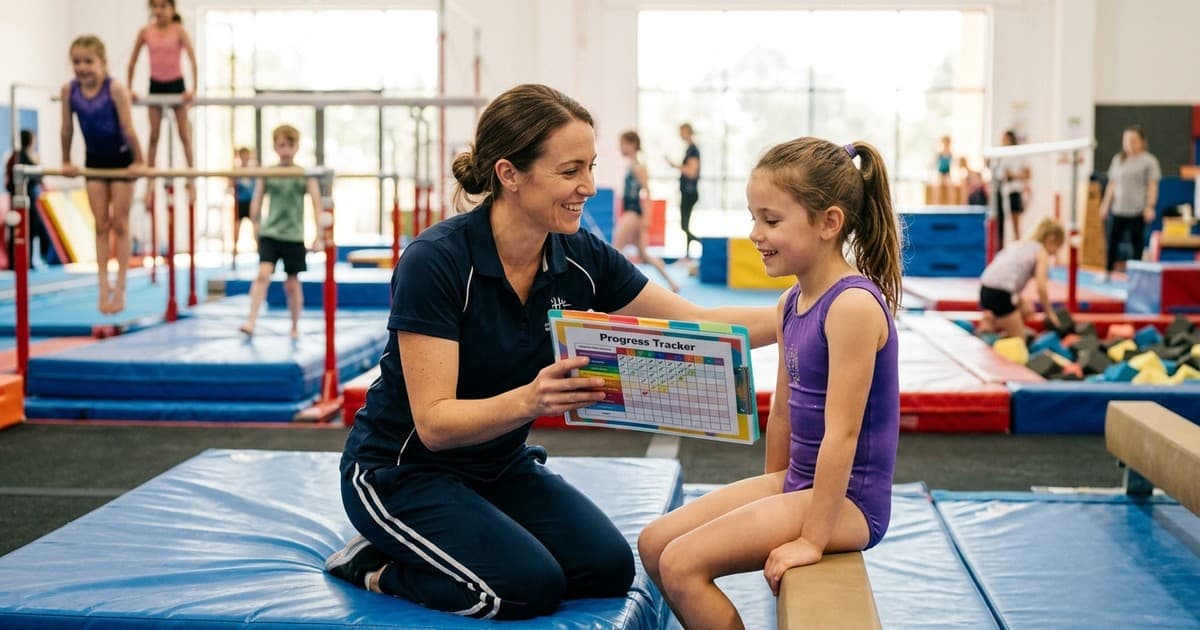
Give every gymnast a personal progress card that lists every skill in their current badge level. As each skill is achieved, the coach stamps, stickers, or signs off that skill on the card. The gymnast keeps the card in their bag and can show it to parents after every session. This is extraordinarily simple and extraordinarily effective. The tangible, physical act of getting a stamp creates a micro-reward that sustains motivation between badge completions.
Digital Progress Dashboards
For parents who want more detail, a digital dashboard provides real-time progress information. Through a parent portal or app, parents can see exactly which skills their child has achieved, which are in progress, and which remain. Progress percentages, historical timelines, and comparisons with typical progression rates all help parents understand that their child is on track even when the next badge feels far away. AMES provides this through its progression tracking module, which updates in real time as coaches log skill completions.
Creating Intermediate Milestones
The BG Proficiency Award scheme provides the major milestones, but the gaps between badges can feel long, particularly at higher levels. Clubs that create intermediate milestones within each badge level see significantly better retention.
Apparatus-Specific Awards
Break each BG badge into apparatus-specific achievements. A gymnast working towards Badge 4 might earn a "Badge 4 Floor" sticker when they complete all the floor skills, even though they are still working on beam and bars. This creates four recognition moments within each badge level instead of one, which is particularly valuable for gymnasts who are strong on some apparatus but developing on others.
Conditioning and Flexibility Awards
Create awards for conditioning milestones that are separate from skills badges. A "Strength Star" for holding a handstand for 30 seconds, a "Flexibility Award" for achieving full splits, or a "Core Challenge" badge for completing a specified conditioning circuit. These awards recognise the foundational work that underpins skill development and give less naturally talented gymnasts a way to earn recognition for effort and physical development.
Effort and Attendance Recognition
Some gymnasts will progress through skill levels quickly; others will take longer. Effort and attendance awards ensure that every gymnast, regardless of natural ability, has opportunities for recognition. A termly "Commitment Award" for gymnasts who attend 90 percent or more of sessions, or a "Coach's Choice" award for the gymnast who showed the most improvement or best attitude, costs very little to implement but has a disproportionate impact on retention.
Bulk Ordering and Cost Management
Managing the physical inventory of badges, certificates, stickers, and awards is an administrative function that scales significantly as your club grows.
Termly Ordering Cycles
Establish a termly ordering cycle aligned with your assessment schedule. If assessment sessions happen in the penultimate week of each half-term, place your badge order in the following week based on actual completions plus a forecast of completions expected in the first few weeks of the next half-term. This means badges arrive early in the new half-term, ready for presentation.
Supplier Relationships
For BG proficiency badges, order through the official British Gymnastics shop. For club-specific awards, build relationships with badge and trophy suppliers who can produce custom designs. Companies such as Dye Sublimation Supplies, Trophy Store, and Badges Plus all offer custom gymnastics badges and medals at reasonable prices for bulk orders. Custom badges with your club logo create stronger brand identity and are more valued by gymnasts than generic designs.
Budget Allocation
Budget between three and eight pounds per gymnast per term for the full range of physical awards (BG badges, club badges, stickers, certificates). This is a remarkably cost-effective retention tool. Consider what you spend on acquiring a new member (marketing, taster sessions, administrative time) versus what it costs to retain an existing one with a well-run progression system. The progression system wins every time.
Digital Certificates and Parent Portal Integration
Physical badges are essential for the gymnast, but digital recognition extends the impact to parents and the wider community.
Automated Certificate Generation
Set up a system that automatically generates a digital certificate when a badge is awarded. The certificate should include the gymnast's name, the badge or award title, the date, the club logo, and the coach's name. PDF format works for downloads; image format works for social media sharing. AMES generates these automatically and makes them available in the parent portal within minutes of a coach logging the badge completion.
Parent Notification Workflow
When a badge is awarded, the parent should receive an automatic notification via email or app push notification. The notification should include a congratulatory message, the digital certificate, details of the next badge in the progression, and a prompt to share the achievement on social media (with a link back to your club). Every shared certificate is free advertising to exactly the right demographic: parents of children the same age as your gymnasts.
Social Media Integration
Make it easy for parents to share achievements. Pre-formatted social media posts with the club's handle, relevant hashtags, and a branded image template give parents a one-click sharing option. Clubs that do this well see measurable increases in enquiries from parents in the same school and social networks as their existing members.
The best progression systems work on two levels simultaneously: they motivate the gymnast with immediate, tangible rewards, and they reassure the parent with visible evidence of progress and value.
Key Takeaways
- Install visual progression charts in the viewing area so parents can see the full pathway and their child's position within it.
- Give every gymnast a personal progress card for individual skill tracking between badge completions.
- Create intermediate milestones such as apparatus-specific awards, conditioning badges, and effort recognition.
- Establish a termly ordering cycle based on assessment data to ensure badges arrive promptly after achievement.
- Budget three to eight pounds per gymnast per term for physical awards as a cost-effective retention investment.
- Automate digital certificate generation and parent notifications to extend the impact of every achievement beyond the gym.