The Unique Equipment Challenge in Gymnastics
Running a gymnastics club is fundamentally different from running a football club or a dance school. Your sport requires large, heavy, expensive apparatus that takes time to set up, time to take down, and space to store. A full gymnastics hall might contain a sprung floor, vault table and run-up, asymmetric bars, balance beams at multiple heights, a pommel horse, rings, a tumble track, foam pits, and a range of supplementary equipment such as springboards, crash mats, and conditioning stations.
Not all of this apparatus is used in every session. Recreational classes use different equipment configurations from squad training. Pre-school gymnastics needs entirely different setups from adult sessions. And if you share your facility with other sports or activities, you may need to break down and rebuild your equipment layout multiple times a day.
Getting apparatus scheduling right directly affects how many sessions you can run, how safe those sessions are, and how burned out your coaching staff become.
Rotation Timing Within Sessions
Within a single gymnastics session, gymnasts rotate between apparatus stations. The timing of these rotations is critical for both learning outcomes and safety.
Calculating Rotation Length
For recreational classes, most clubs use rotations of eight to twelve minutes per station, with a one to two minute transition between rotations. The rotation length depends on the group size, the coach-to-gymnast ratio, and the complexity of the skills being practised. Younger and less experienced gymnasts need shorter rotations because their attention spans are shorter, but they also need more transition time because moving groups of small children between apparatus safely takes longer than you expect.
For squad training, rotations are typically longer (15 to 25 minutes) because gymnasts are working on specific skill progressions that need sustained practice. Competition squad athletes may spend an entire session on one or two apparatus if they are preparing for a specific event.
Building Rotation Schedules
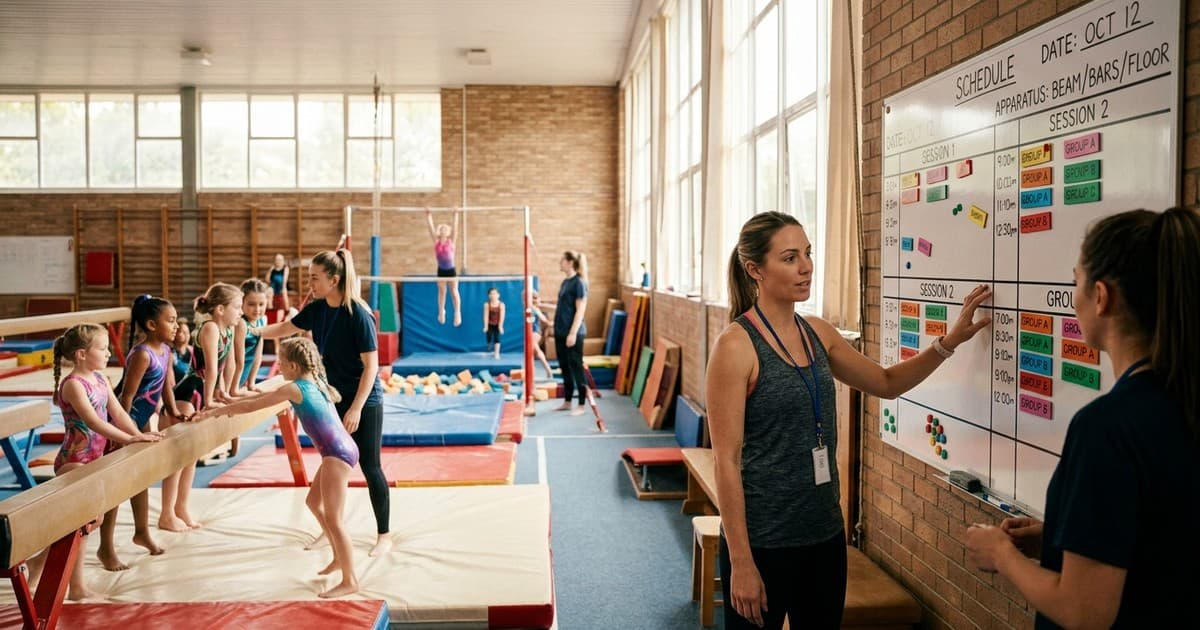
Map out your rotation schedule for each class format before the term begins. Specify which apparatus stations are active, how many gymnasts are at each station, which coach is responsible for each station, and the rotation order. Pin these schedules to the wall near each station so that coaches and gymnasts know where they should be at every point in the session.
Account for the warm-up and cool-down in your total session time. A 60-minute class with a 10-minute warm-up and a 5-minute cool-down gives you 45 minutes of apparatus time. With four stations and two-minute transitions, that is approximately nine minutes per rotation, which works well for recreational groups.
Setup, Teardown, and Changeover Logistics
Setup and teardown is where many gymnastics clubs lose significant operational time and put unnecessary strain on staff.
Standardised Layout Maps
Create a printed layout map for every class configuration your club runs. Laminate them and store them in the equipment shed or on a notice board. Each map should show exactly where every piece of apparatus goes, including mat placements, springboard positions, and safety zone clearances. When a new coach or volunteer is helping with setup, they should be able to follow the map without needing verbal instruction.
Minimising Changeovers
Schedule classes that use similar apparatus configurations back to back. If your Monday evening runs a recreational class followed by a squad session, and both use the floor, beam, and bars, you avoid a complete teardown between sessions. The squad session might add vault and adjust beam heights, which takes five minutes rather than the 20 to 30 minutes of a full reconfiguration.
Conversely, scheduling a pre-school class (which uses low-level soft play equipment, floor mats, and toddler-height beams) immediately before a competitive squad session (which requires full-height apparatus, pit access, and tumble track) creates a massive changeover that either eats into session time or requires additional staff specifically for the changeover.
Staff Allocation for Setup
Be explicit about who is responsible for setup and teardown. In many clubs, this defaults to whichever coach arrives first and whichever coach is slowest to leave, which breeds resentment. Allocate setup and teardown time as part of coaching contracts. If setup takes 20 minutes and teardown takes 15 minutes, coaches should be paid for those 35 minutes on top of their coaching hours. The alternative is that setup is rushed, safety checks are skipped, and your best coaches burn out and leave.
Safety Inspections and Compliance
Gymnastics apparatus is subject to specific safety requirements under British Gymnastics guidance and broader health and safety legislation.
Pre-Session Checks
Before every session, the lead coach must complete a visual and physical check of all apparatus. This includes checking that bolts are tight, cables are not frayed, mats are correctly positioned and not worn through, foam pit fill is at the correct level, and safety zones around apparatus are clear of obstructions. British Gymnastics recommends a documented pre-session checklist, and many insurers require one as a condition of cover.
Annual Inspections
All gymnastics apparatus must be formally inspected at least annually by a qualified equipment inspector. In the UK, companies such as Continental Sports, Gymnova, and Janssen-Fritsen provide inspection services. Keep inspection certificates on file and make them available to your insurer and to British Gymnastics upon request. Failed items must be taken out of service immediately and either repaired or replaced before reuse.
Documenting Everything
Maintain a log of every pre-session check, every reported defect, every repair, and every annual inspection. This documentation is your primary defence if there is ever an accident or an insurance claim. Digital logging systems are more reliable than paper because they timestamp entries automatically and cannot have pages removed or altered. AMES provides equipment tracking features that let clubs log checks, flag issues, and track resolution, all with a clear audit trail.
Managing Shared Facilities
Many gymnastics clubs do not own their own dedicated facility. They operate in school halls, leisure centres, community centres, or shared sports halls. This adds a layer of scheduling complexity that dedicated-facility clubs do not face.
Storage and Transport
If your apparatus needs to be stored and transported to the training venue, invest in proper storage solutions. Beam trolleys, mat storage racks, and bar transport wheels save time and reduce the risk of injury during setup. Equipment should be stored in a dry, secure location. Moisture damage to wooden apparatus or corrosion on metal frames creates safety hazards that are expensive to remedy.
Negotiating Facility Time
When booking shared facility time, factor in setup and teardown. If your session runs from 4pm to 6pm, you need the hall from 3:30pm and must be clear by 6:30pm. Book the full window, not just the coaching time. Negotiate bulk booking rates for the term rather than paying per session, and get agreements in writing. The most common complaint from clubs in shared facilities is losing their booking to another hirer at short notice.
Adapting Your Programme
Shared facilities often have restrictions: no chalk, no bare feet, no apparatus bolted to the floor, limited ceiling height. Design your programme around these constraints rather than fighting them. Floor and vault skills, tumbling, body conditioning, flexibility, and dance elements can all be trained effectively in a standard sports hall. Save the specialist apparatus work for sessions in your primary venue, and use shared facility time for the elements that do not require permanent installations.
Your apparatus schedule is not just a timetable. It is a safety document, a staffing plan, and a commercial strategy rolled into one. Treat it accordingly.
Key Takeaways
- Calculate rotation lengths based on group age, ability, coach ratios, and total session time minus warm-up and cool-down.
- Create laminated layout maps for every class configuration so setup is consistent regardless of which staff are on duty.
- Schedule classes with similar apparatus needs back to back to minimise changeover time.
- Pay coaches for setup and teardown time separately from coaching hours to prevent burnout and rushed safety checks.
- Complete documented pre-session apparatus checks before every session and keep annual inspection certificates on file.
- In shared facilities, book the full setup-to-teardown window and design your programme around venue constraints.