Why Development Tracking Matters in Youth Football
Every parent who enrols their child in a football academy wants to know one thing: is my child improving? That question sounds simple, but answering it properly requires a structured approach to development tracking that goes far beyond the match-day statistics most people think of. Goals scored and matches won tell you almost nothing about whether a nine-year-old is developing the technical, tactical, physical, and psychological skills they need to fulfil their potential.
The FA has invested heavily in defining what good youth development looks like through the FA DNA programme. This framework provides a common language for what English football wants its young players to learn at each stage of development. For academy operators, it also provides a structure for tracking progress in a way that is meaningful, consistent, and communicable to parents.
The FA DNA Framework and Four-Corner Model
Understanding FA DNA
FA DNA is the FA's blueprint for player development. It defines the playing style, coaching methodology, and development priorities for English football from grassroots to the senior international team. At its core, it describes the kind of player England wants to produce: technically excellent, tactically intelligent, physically robust, and mentally resilient.
For grassroots and community academies, FA DNA provides a development framework organised into phases that align with age groups. The Foundation Phase (under-5 to under-8) emphasises fun, basic movement, and ball familiarity. The Youth Development Phase (under-9 to under-12) focuses on developing core technical skills and introducing tactical concepts. The Youth Phase (under-13 to under-16) adds physical development and more sophisticated tactical understanding.
The Four-Corner Model
The FA's four-corner model is the practical tool for holistic player development. Every young player should be assessed and developed across four interconnected areas:
- Technical: Ball mastery, passing, receiving, shooting, heading, dribbling, and the ability to execute skills under pressure
- Tactical: Understanding of space, positioning, decision-making in possession and out of possession, and game awareness
- Physical: Agility, balance, coordination, speed, strength (age-appropriate), and endurance
- Psychological: Confidence, concentration, communication, resilience, and the ability to cope with setbacks
Each of these corners carries equal weight. A technically gifted player who crumbles under pressure is not fully developed. A physically dominant under-12 who cannot make a five-yard pass under pressure has a gap that will become a barrier as opponents catch up physically. Your development tracking system should assess all four corners, not just the ones that are easiest to measure.
The four-corner model is not just an assessment tool. It is a coaching philosophy. When your coaches plan sessions, they should be consciously developing all four corners, not just running drills that improve technique in isolation.
Practical Assessment Methods
Coach Observation and Rating
The most accessible assessment method is structured coach observation. Rather than asking coaches to write paragraphs about each player, provide a simple rating framework: a 1-to-4 scale across key competencies within each corner. For example, under the Technical corner, you might assess first touch, passing accuracy, and 1v1 dribbling. Under the Psychological corner, you might assess reaction to mistakes, communication with teammates, and effort levels.
Assess each player termly (three times per season) and record the ratings in a central system. Over time, this builds a development trajectory that shows whether a player is progressing, plateauing, or regressing in each area. AMES supports custom assessment frameworks where you define the competencies and rating scale, and coaches submit assessments through the coaching app during or after sessions.
Video Assessment
Video is one of the most powerful development tools available to youth football coaches, and it has never been more accessible. A smartphone on a tripod at the side of a training pitch or match captures everything you need. The value of video is that it provides objective evidence that supplements coach observation.
For tactical development, video allows you to pause and replay moments where a player made a good or poor decision, showing them what they did and what they could have done differently. For technical development, slow-motion video of a player's shooting or passing technique can reveal issues that are invisible at full speed. For psychological assessment, video of a player's body language after a mistake tells you more than any rating scale.
The challenge with video is time. Reviewing ninety minutes of match footage for every player every week is not realistic for a grassroots academy. Instead, use video selectively: record key sessions or matches, clip specific moments that illustrate development points, and share these clips with players and parents as part of progress reports.
Skill Challenges and Benchmarking
Periodic skill challenges provide standardised data points that complement subjective coach assessments. These might include timed dribbling courses, passing accuracy tests, or small-sided game scenarios with specific outcomes to achieve. The FA's own player development reviews include elements like this at professional academy level, and there is no reason grassroots academies cannot run simplified versions.
The key is consistency. If you run a ball mastery challenge in September, repeat it with the same format in January and May. The comparison across the season is what makes the data valuable, not the absolute score at any single point.
Progress Reports for Parents
What Parents Want to Know
Parents want three things from a progress report: confirmation that their child is in the right programme, evidence that they are developing, and specific guidance on what they can practice at home or focus on next. They do not want generic statements like 'good effort this term' or a page of statistics they cannot interpret.
A good progress report for a youth football player includes:
- A summary of the focus areas for the term (linked to FA DNA phase priorities)
- Ratings across the four corners with brief explanations of what each rating means
- One or two specific strengths to celebrate
- One or two specific development areas with practical suggestions
- A video clip or photo illustrating a key development moment (optional but highly valued)
Frequency and Format
Termly progress reports (three per season) are the most common and manageable frequency. More frequent than this and the administrative burden becomes unsustainable for coaches. Less frequent and parents feel they are not getting value from the academy fees.
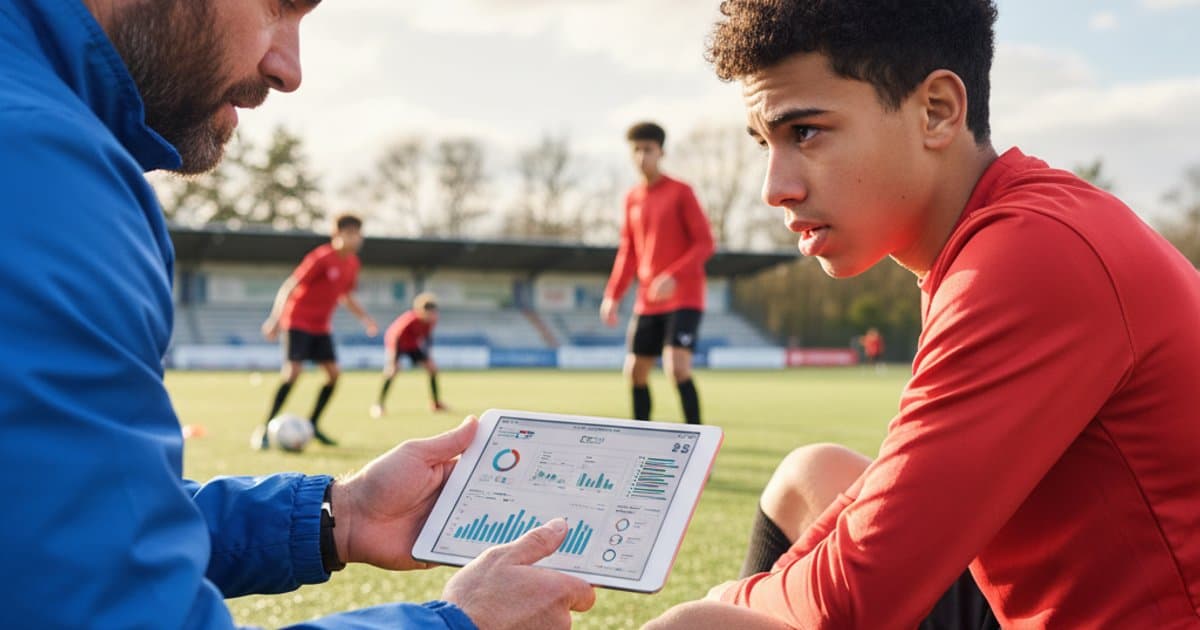
Digital reports delivered through a parent portal are more effective than printed reports. They can include video links, they are searchable and archivable, and they prompt a natural conversation between the parent and child about their football development. AMES generates progress reports from coach assessments and makes them available to parents through the app, complete with historical comparison to show development over time.
Key Takeaways
- Use the FA DNA framework to structure your development programme by age-appropriate phase
- Assess all four corners of the development model: technical, tactical, physical, and psychological
- Use a simple rating scale (1 to 4) that coaches can complete quickly and consistently
- Assess each player termly and track progression over time rather than focusing on single-point snapshots
- Use video selectively to support coach observations and share key clips with parents
- Produce termly progress reports that include specific strengths, development areas, and practical suggestions
- Deliver reports digitally through a parent portal for easy access, archiving, and historical comparison