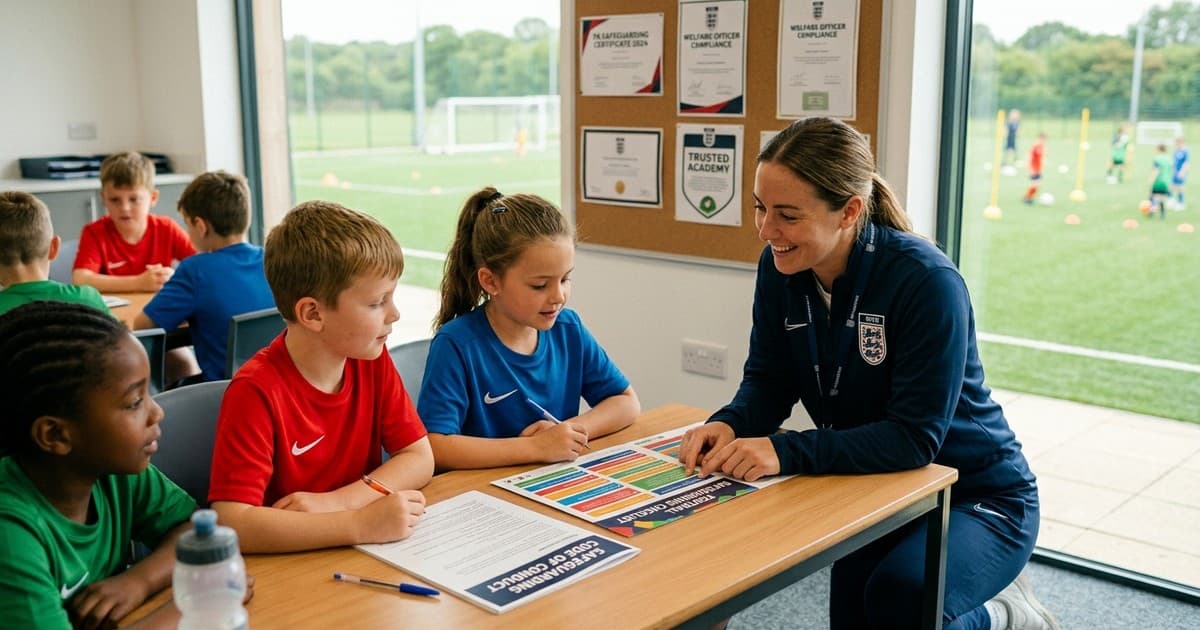
Why Compliance Is Non-Negotiable
Running a football academy places you in a position of significant responsibility. Parents entrust their children to your care, and the law, the FA, and your insurance provider all hold you accountable for maintaining standards that protect those children. Compliance is not bureaucracy for its own sake. It is the framework that ensures every coach in your academy is qualified, vetted, trained, and prepared to respond if something goes wrong.
The consequences of compliance failures are severe. An unqualified coach is not covered by your insurance. A lapsed DBS check puts your FA affiliation at risk. A missing emergency action plan could cost a child's life. These are not hypothetical scenarios. They are the real-world consequences that the compliance framework is designed to prevent.
FA Coaching Qualifications
The FA Coaching Pathway
The FA operates a structured coaching qualification pathway that all coaches in your academy should be following. The levels are:
- FA Playmaker: A free, online introduction to coaching aimed at parents and volunteers who help at sessions. It does not qualify someone to coach independently, but it provides a foundation of understanding.
- FA Introduction to Coaching Football (previously Level 1): A practical course that equips volunteer coaches to plan and deliver basic sessions. This is the minimum qualification for anyone leading part of a training session. The course runs over approximately 30 hours and costs £150 to £200.
- FA Certificate in Coaching Football (previously Level 2): The standard qualification for coaches who lead sessions independently. This is the qualification you should expect from every coach on your staff. The course is approximately 80 to 120 hours of learning and assessment, costing £400 to £600.
- FA Advanced Youth Award: Aimed at coaches working in youth development environments, this qualification deepens understanding of long-term player development and the FA DNA framework. It is relevant for coaches leading performance squads within your academy.
- UEFA B Licence: An internationally recognised qualification for coaches working at a high performance level. The course runs over several months and costs approximately £1,200 to £1,800. Having a UEFA B-qualified head coach is a strong differentiator for your academy.
- UEFA A Licence and UEFA Pro Licence: Elite qualifications for coaches operating at professional and international levels. Most community academies will not need coaches at this level, but it is worth noting for your long-term development plan.
Continuing Professional Development
FA qualifications require ongoing CPD to remain valid. Coaches must complete CPD activities annually and log them through the FA Learning platform. CPD can include FA-organised workshops, webinars, mentoring, self-directed study, or attending conferences. Your academy should support coaches in meeting their CPD requirements by sharing opportunities, funding attendance at events, and building time for professional development into the coaching calendar.
A coaching qualification is a starting point, not an endpoint. The best academies invest in their coaches' ongoing development because better coaches produce better players and deliver better experiences for families.
DBS Checks and Safeguarding Training
Enhanced DBS with Barred List Check
Every coach, assistant, volunteer, and administrator who has regular contact with children must hold an enhanced DBS check with a barred list check. This is a requirement of the FA, your insurance provider, and the law. There are no exceptions and no grace periods for new staff.
The process involves an application through your County FA or an umbrella body, providing identity documents, and waiting for the DBS to process the check. Processing times vary from two to eight weeks, and you must not allow an individual to have unsupervised contact with children until their check has cleared.
DBS checks do not have an expiry date, but the FA and most insurers expect renewal every three years. The DBS Update Service (£13 per year, paid by the individual) allows you to check the status of a DBS certificate instantly online, which is invaluable for monitoring compliance across your coaching team without re-running full checks annually.
Safeguarding Training
All coaches must complete the FA Safeguarding Children Workshop before they begin coaching. This workshop covers recognising abuse and neglect, responding to concerns, the role of the Club Welfare Officer, and the FA's reporting procedures. The workshop must be renewed every three years.
Your Club Welfare Officer (CWO) has additional training requirements. They must complete the FA Welfare Officer Workshop and the FA Safeguarding Children Workshop, both renewed every three years. The CWO is your first point of contact for safeguarding concerns and must be named in your FA affiliation.
First Aid Certification and Emergency Action Plans
First Aid Requirements
At minimum, one qualified first aider must be present at every training session and match. The FA requires coaches to hold a current FA Emergency First Aid in Football qualification or an equivalent first aid certificate. The FA's own course is designed specifically for the football environment and covers cardiac emergencies, head injuries, fractures, soft tissue injuries, and the specific protocols for managing injuries on a pitch.
Best practice is to have two qualified first aiders at every session, so that if one is dealing with a casualty, the other can manage the rest of the group. Ensure your first aid kit is checked and restocked monthly, and that it includes items specific to football injuries: cold spray, instant ice packs, wound closure strips, and a blanket.
Emergency Action Plans
Every venue your academy uses should have a documented Emergency Action Plan (EAP). The EAP should be specific to the venue and cover:
- Emergency services access: The exact address and postcode of the venue, the best access point for an ambulance, and any gates or barriers that might need to be unlocked
- Nearest hospital: The name, address, and route to the nearest A&E department
- Defibrillator location: Whether there is an AED on site, where it is located, and who has the access code
- Emergency contacts: The venue manager's phone number, the academy's emergency phone, and the relevant emergency services numbers
- Roles and responsibilities: Who calls 999, who administers first aid, who manages the other children, and who contacts the injured child's parents
Print the EAP and keep a copy in every first aid kit. Ensure every coach has read and understood the EAP for every venue they work at. Review and update EAPs annually or whenever venue details change.
Incident Logging and Record Keeping
What to Log
Every incident, no matter how minor, should be recorded. This includes injuries, near-misses, behavioural incidents, safeguarding concerns, and complaints. The log should capture the date, time, location, people involved, a factual description of what happened, the action taken, and the outcome. Records must be signed by the person who dealt with the incident and stored securely.
Why Logging Matters
Incident logs serve three purposes. First, they protect you legally. If a parent makes a claim six months after an injury, your incident log is your evidence of what happened and how you responded. Second, they reveal patterns. If the same child is repeatedly involved in behavioural incidents, or if injuries cluster at a particular venue, the log data helps you identify and address the root cause. Third, they demonstrate compliance to the FA, Ofsted (if you provide childcare-registered holiday camps), and your insurer.
AMES provides digital incident logging with mandatory fields that ensure every record is complete. Incidents are linked to the relevant player, session, and venue, and are accessible only to authorised personnel. Automated alerts notify the Club Welfare Officer when a safeguarding-related incident is logged, ensuring nothing falls through the cracks.
Key Takeaways
- Ensure every coach holds at minimum an FA Certificate in Coaching Football and current FA Safeguarding Children Workshop
- Require enhanced DBS checks with barred list for all staff and volunteers, renewed every three years
- Encourage coaches to join the DBS Update Service for instant status verification
- Maintain at least one qualified first aider at every session, with two as best practice
- Create a venue-specific Emergency Action Plan for every location your academy uses
- Log every incident with mandatory fields and store records securely with restricted access
- Support coaches' CPD by sharing opportunities, funding attendance, and building development time into your calendar