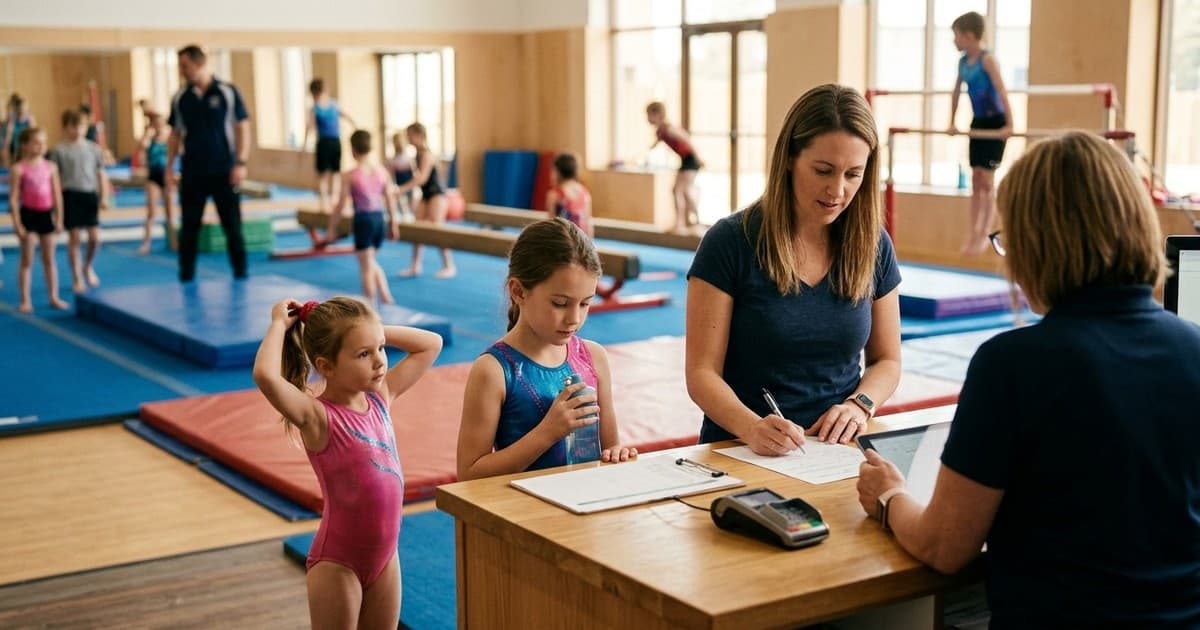
The True Cost of Manual Payment Collection
If you are still collecting payments by bank transfer, cash, or cheque, you are spending far more time on payment administration than you realise. Consider what happens each term: you calculate fees for every gymnast, send out invoices, chase the families who do not pay by the deadline, reconcile payments against your bank statement, follow up on partial payments, manage refund requests for missed sessions, and deal with the families who simply stop paying without telling you they are leaving.
In a club of 200 gymnasts, this process can consume 15 to 20 hours of administrative time every term. For a club of 500, it can be a part-time job. And the indirect costs are even higher: late payments damage your cash flow, awkward payment conversations damage your relationship with families, and the stress of chasing money drives volunteers and administrators away from the role.
Automated payment collection eliminates nearly all of this. Payments are collected on schedule, reconciliation is automatic, and the system handles the uncomfortable conversations for you.
Monthly Direct Debit for Squad Subscriptions
Squad gymnasts train year-round, and their fees should be collected on a monthly direct debit. This is the standard approach across UK gymnastics and for good reason.
Setting Up Direct Debit
To collect direct debits, you need a Direct Debit Originator number from Bacs or you can use a payment provider that acts as a bureau on your behalf. Providers such as GoCardless, Stripe (with BACS Direct Debit), and integrated club management platforms like AMES handle the technical infrastructure so you do not need to become a direct debit expert. The setup process for parents is simple: they complete an online mandate (taking about two minutes), and payments are collected automatically on the same date each month.
Calculating Monthly Squad Fees
Most clubs calculate monthly squad fees by dividing the annual cost by 12, even though training hours vary across the year (less during holidays, more in the run-up to competitions). This gives parents a predictable monthly amount and gives the club predictable monthly revenue. A squad gymnast training 12 hours per week with a weekly rate of eight pounds per hour would have an annual cost of approximately 4,992 pounds (12 hours x 8 pounds x 52 weeks), giving a monthly fee of 416 pounds. Adjust this based on actual training weeks per year, typically 46 to 48 allowing for holiday closures.
Handling Squad Fee Changes
Give families at least one full month's notice before any fee change, and explain the reason. Implement changes at the start of a new term or training year, not mid-term. Your direct debit provider or management platform should allow you to schedule fee changes in advance so they apply automatically without manual intervention.
Termly Payment Collection for Recreational Classes
Recreational gymnastics traditionally operates on a termly basis, with families paying for a block of sessions at the start of each term.
Moving from Termly Invoice to Automated Collection
The simplest transition is to move from manual invoicing to automated termly payment collection. Parents set up a card or direct debit mandate once, and the system charges the termly fee automatically at the start of each term. This eliminates the start-of-term payment chase that consumes so much administrative time. Families who have not paid by the session start date are automatically flagged, and a polite reminder is sent without any human involvement.
Monthly Spreading for Recreational Fees
An increasingly popular alternative is to offer recreational families the option to spread termly fees across monthly payments. A term of 12 sessions at ten pounds each (120 pounds total) can be collected as three monthly payments of 40 pounds. This is easier on family budgets, particularly for those with multiple children, and it improves your cash flow predictability. The trade-off is slightly more complex administration, but an automated system handles this effortlessly.
Pro-Rata and Mid-Term Joiners
Automating pro-rata calculations for gymnasts joining mid-term removes another manual task. If a gymnast joins in week four of a 12-week term, the system calculates the fee for the remaining eight sessions and charges accordingly. This encourages mid-term enrolment rather than telling families to wait until next term, which risks losing them entirely.
Competition Levies and One-Off Charges
Beyond regular fees, gymnastics clubs have a range of additional charges that need collecting: competition entry fees, training camp costs, display event tickets, and examination fees.
Annual or Termly Competition Levies
For squad gymnasts, a competition levy collected monthly alongside training fees is the most efficient approach. Calculate the club's total expected competition costs for the year (entry fees, venue hire for internal competitions, medals, judge expenses) and divide by 12 or by the number of squad members. This smooths the cost and avoids the need to chase individual payments for each competition.
One-Off Charges Through the Platform
For occasional charges such as display tickets, leotard orders, or training camp fees, use your management platform to generate and collect one-off payments. Parents receive a notification with the amount and reason, and they pay through the same platform they use for regular fees. No separate bank transfers, no cash in envelopes, no reconciliation headaches.
Uniform and Merchandise Sales
Many gymnastics clubs sell branded leotards, tracksuits, bags, and accessories. Managing this through your payment platform rather than as a separate cash operation simplifies both the purchasing experience for parents and the accounting for the club.
Online Club Shop
Set up an online shop within your management platform where parents can browse available items, select sizes, and pay directly. Orders are logged automatically, and you can fulfil them in batches. This is far more efficient than taking orders on paper forms and collecting cash, which inevitably leads to lost orders, wrong sizes, and missing payments.
Sizing and Returns
Gymnastics leotards and clothing are notoriously difficult to size, especially for children who are growing. Hold termly sizing sessions where families can try on sample sizes before ordering. This reduces returns significantly. For online orders, publish detailed sizing charts with body measurements rather than age guides, and have a clear returns policy displayed at the point of purchase.
Sibling Discounts and Complex Pricing
Gymnastics clubs often have families with two, three, or even four children attending different classes. Managing sibling discounts manually is error-prone and time-consuming.
Automated Discount Rules
Configure your payment system to apply sibling discounts automatically based on the number of children from the same family enrolled in the club. A typical structure is: first child pays full price, second child receives 10 percent off, third child and beyond receives 15 to 20 percent off. The system should calculate this across all programmes, so a family with one child in recreational and another in squad receives the discount on whichever programme is cheaper.
Multi-Programme Discounts
A gymnast attending both recreational classes and squad training, or attending gymnastics plus a second activity your club offers (such as cheerleading or trampolining), should receive a multi-programme discount. Configure this as a separate rule from the sibling discount, and ensure the system applies the most beneficial combination for the family. Transparent, automatically applied discounts build trust and loyalty.
Every minute your team spends chasing payments is a minute they are not spending on coaching, programme development, or building relationships with families. Automate the money, and focus on the gymnastics.
Key Takeaways
- Move squad fees to monthly direct debit calculated as the annual cost divided by 12 for predictable revenue and family budgets.
- Automate termly recreational fee collection so payments are charged at the start of each term without manual invoicing.
- Offer monthly spreading options for recreational fees to improve affordability and reduce payment chasing.
- Collect competition levies as part of monthly squad fees rather than chasing individual entry fee payments.
- Run uniform and merchandise sales through your management platform to eliminate cash handling and manual order tracking.
- Configure sibling and multi-programme discounts to apply automatically based on family enrolment data.