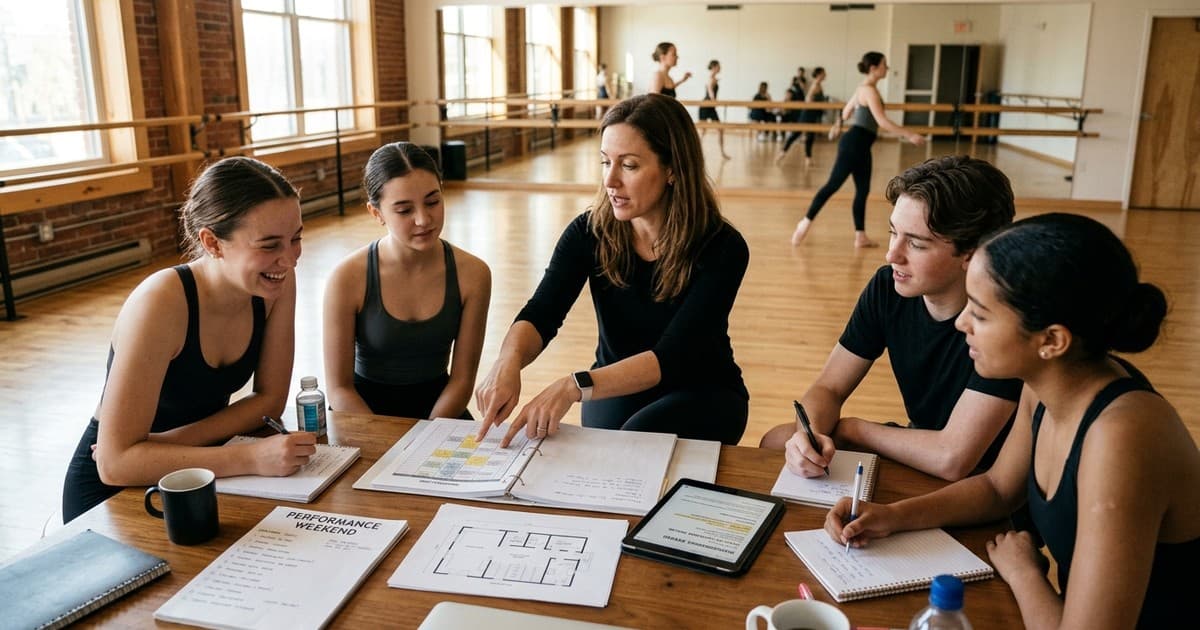
The Show Is Your Shop Window
Nothing showcases your dance school like a well-run performance. It is the moment when parents see the results of their investment, when pupils experience the thrill of performing, and when prospective families in the audience decide whether to enrol their children. A polished show builds your reputation. A chaotic one damages it, regardless of how good the dancing is.
The difference between a polished show and a chaotic one is rarely about talent or budget. It is about planning, coordination, and communication. Schools that invest in the logistics of their performances, the running order, the backstage organisation, the technical preparation, and the front-of-house experience, deliver shows that feel professional even in a village hall.
This guide covers the operational aspects of performance management: the systems and processes that make a dance school show run smoothly from first planning meeting to final curtain call.
Building the Running Order
Structuring the Programme
A running order is not just a list of dances. It is the dramatic arc of your show. Start with an opening number that sets the energy and includes as many dancers as possible. Vary the pace, alternating high-energy pieces with slower, more lyrical numbers. Spread disciplines throughout the show so the audience sees variety rather than forty-five minutes of ballet followed by forty-five minutes of tap. End each half with a strong number, and close the show with your best piece or a full-company finale.
Consider the practical constraints alongside the artistic ones. If a group of dancers appears in two consecutive numbers, they need time for a costume change. If a piece requires special lighting or staging, schedule it where the tech team has time to set up. If your youngest performers are in the show, put them in the first half before tiredness and nerves take their toll.
Managing Quick Changes
Quick changes, where a dancer exits one number and must reappear in a different costume for the next, are a major source of backstage stress. Map every quick change on your running order: which dancers, which costumes, how long they have, and who is helping them change. If a change requires less than two minutes, you need a dedicated helper, a pre-laid costume, and a rehearsed process. If a change is physically impossible in the time available, adjust the running order. Better to move a number in the programme than to have a dancer appear on stage in the wrong costume.
Cast Lists and Backstage Calls
Publishing Cast Lists
Cast lists should be published as early as possible so parents can plan logistics. For each performance, provide a list showing every number, the cast members in each, and the approximate time they will be needed backstage. Parents of younger children need to know when to arrive and when their child will be finished so they are not waiting for three hours in a corridor.
Make cast lists available through your parent portal and as a printed document at the venue. Include a note reminding parents that running times are approximate and that children must remain backstage until released by their chaperone, not collected by parents from the wings.
Backstage Call Schedules
A backstage call schedule tells each group of dancers when to arrive backstage, where to go, and when they are on stage. Stagger calls so that you do not have every dancer arriving at once. A typical approach is to call dancers thirty minutes before their first number. For younger children who need help with costumes and hair, allow more time. For older, experienced dancers, twenty minutes may be sufficient.
Assign specific holding areas for each age group. Small children waiting backstage with nervous energy need a supervised, contained space away from the stage wings. Older dancers can wait in a green room or corridor. Label each area clearly and brief chaperones on which group goes where.
Tech Rehearsals and Venue Coordination
Working with Your Venue
Whether you are performing in a professional theatre, a community hall, or a school auditorium, the relationship with your venue is critical. Establish a single point of contact at the venue and agree on access times for get-in (when you load equipment and set up), tech rehearsal, dress rehearsal, performances, and get-out (when you strike the set and clear the venue). Get these agreements in writing. A verbal promise about Saturday morning access is worthless if the venue manager is on holiday that day.
Confirm the technical specifications of the venue: the number and type of lighting fixtures, the sound system capabilities, backstage space, wing space, the number of dressing rooms, access to power for hair and make-up, and any restrictions (no naked flames, no confetti, no smoke machines without prior arrangement). The more you know in advance, the fewer surprises you will face on show day.
Technical Requirements
Prepare a technical specification document for your show that lists every number, its music track, any special lighting requirements, staging elements, and sound effects. Give this to your lighting and sound operators well in advance so they can programme cues before the tech rehearsal. The tech rehearsal itself should then be about refining and adjusting, not about seeing the show for the first time.
If you are hiring additional equipment (extra lights, a follow spot, haze machines), arrange this at least a month in advance and confirm delivery and collection dates. Budget for a technician to operate hired equipment if your regular volunteers are not comfortable with it.
Ticket Sales and Front of House
Setting Up Ticket Sales
Decide early whether tickets will be allocated seating or general admission. Allocated seating requires a seat map, which is more complex to set up but prevents the scramble for seats that general admission creates. For larger venues, allocated seating is strongly recommended. For smaller venues with fewer than two hundred seats, general admission may be simpler.
Sell tickets through your management system or parent portal if possible, rather than relying on cash at the door. Online ticket sales give you real-time visibility of how many tickets have been sold per performance, which helps you decide whether to add an extra show or to promote a performance that is not selling well. Send ticket confirmation by email with a QR code or reference number for easy check-in on the day.
Programme Printing
A printed programme adds professionalism to your show and serves as a keepsake for families. Include the running order, cast lists, teacher biographies, a message from the principal, acknowledgements, and any sponsor advertisements. Design it early and proofread it thoroughly. A programme with misspelled names or incorrect running orders undermines the professional impression you are trying to create.
Consider selling advertising space in the programme to local businesses. This can offset or entirely cover the printing cost, turning the programme from an expense into a revenue source. Approach businesses that are relevant to your audience: children's clothing shops, party venues, local restaurants, and dance equipment suppliers.
Photo, Video, and Post-Show Galleries
Photography and Videography
Professional photography and videography of your show serve multiple purposes: they provide parents with memories, supply your marketing with content, and create a historical record of your school's productions. Hire a professional photographer for at least one performance and arrange for video recording of the full show. Ensure you have consent from all parents for photography and video before the show, using your parent portal to collect this efficiently.
After the show, make photos available through a private online gallery. Many schools use password-protected galleries where parents can view and purchase prints. This can be arranged with the photographer as part of their fee, or you can host the gallery yourself through your parent portal or website.
Key Takeaways
- Structure your running order with artistic variety and practical logistics in mind, including costume change times and age-appropriate scheduling.
- Map every quick change with named helpers, pre-laid costumes, and rehearsed processes, adjusting the running order if changes are impossible.
- Publish cast lists and backstage call schedules early through your parent portal and as printed documents at the venue.
- Establish written agreements with your venue covering access times, technical specifications, and any restrictions.
- Prepare a technical specification document for your lighting and sound operators well before the tech rehearsal.
- Sell tickets online through your management system for real-time visibility and a smooth check-in experience on show day.
- Produce a professionally printed programme and consider selling advertising space to offset costs.
- Hire a professional photographer, collect consent digitally, and share photos through a private post-show gallery.