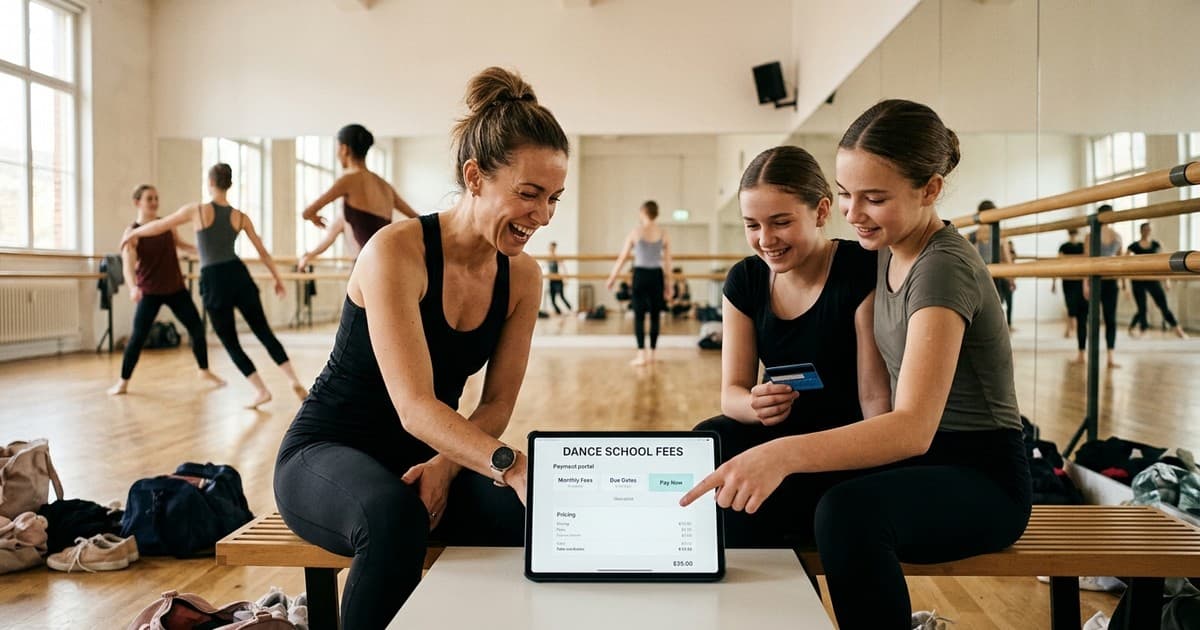
The True Cost of Manual Payment Collection
If you are still collecting payments by bank transfer, cheque, or cash in an envelope, you are spending hours every week on work that a system could do for you. Manual payment collection does not just take time. It creates errors, delays your cash flow, damages relationships when you have to chase parents for late payments, and makes it almost impossible to know your financial position at any given moment.
Dance schools have an unusually complex payment landscape compared to many children's activity providers. You are not just collecting a single term fee. You are managing term fees across multiple classes per pupil, exam fees that vary by board and level, costume payments with deposits and balances, show tickets, uniform purchases, and potentially workshop or holiday course fees on top. Each payment type has its own timing, amount, and set of payers. Without automation, keeping track of all this is a full-time job.
This guide covers how to automate each of these payment types, reduce your debtor list, and free up the hours you currently spend on financial administration.
Automating Term Fees
Setting Up Recurring Collection
Term fees are the core revenue of your dance school, and they should be the easiest payment to collect. The gold standard is Direct Debit, which allows you to collect the correct amount on a set date each term or month without the parent having to do anything. Once a parent sets up a Direct Debit mandate, you control the collection. They receive advance notice of each collection, and the money arrives predictably.
For schools that do not yet have Direct Debit facilities, card-on-file recurring payments are the next best option. The parent enters their card details once, and you charge the card on the agreed dates. This is less robust than Direct Debit (cards expire and get replaced), but it is vastly better than waiting for manual bank transfers.
AMES supports both Direct Debit and card-on-file payments, with automatic retries for failed collections and notifications to parents when a payment fails. This means you are not chasing individual parents for bounced payments. The system does it for you, and you only get involved when repeated attempts fail.
Handling Multi-Class Families
Families with children in multiple classes often expect a single consolidated invoice rather than separate charges for each class. Your payment system should be able to generate a family account that totals all class fees across all siblings, applies any discounts, and produces a single collection amount. This is cleaner for parents and reduces the number of individual transactions you need to reconcile.
Exam Fees, Costume Payments, and Ad-Hoc Charges
Exam Fee Collection
Exam fees are ad-hoc charges that arise at specific points in the year. They vary by board, discipline, and level, and they need to be collected before you can submit entries. The most efficient approach is to generate exam fee invoices automatically when you confirm a pupil's exam entry. The invoice should show the board, discipline, grade, fee amount, and payment deadline. If the parent is on Direct Debit, the exam fee can be added to their next collection. If not, they receive a payment link or invoice that they can pay online.
Costume Payment Workflows
Costume payments typically involve a deposit when the order is placed and a balance payment when the costume is delivered. This two-stage payment needs a different workflow from term fees. Set up costume payments as staged invoices: the first invoice for the deposit goes out when the costume order is confirmed, and the second invoice for the balance goes out when costumes arrive. Link both invoices to the specific costume item so you can see at a glance which costumes have been fully paid for and which have outstanding balances.
Show Tickets and Merchandise
Show ticket sales introduce a retail element to your payments. Parents need to be able to browse available performances, select seats or tickets, and pay online. If you are handling ticket sales through your management system rather than a third-party ticketing platform, you need a simple e-commerce flow: select show, select performance date, select number of tickets, pay. Confirmation should be immediate, and tickets should be deliverable as a PDF or mobile ticket.
Instalment Plans and Flexible Payment Options
Why Instalments Matter
Dance is not a cheap activity. When you add up term fees for two or three classes, exam fees, costume costs, uniform, and show tickets, a family might be looking at several hundred pounds per term. Offering instalment plans makes your school accessible to more families and reduces the risk of non-payment, because smaller, regular amounts are easier for parents to manage than large lump sums.
A typical instalment plan splits the term fee into monthly payments. For a twelve-week term costing one hundred and fifty pounds, a three-monthly-instalment plan of fifty pounds per month is easier for many families to absorb. The key is to make the instalment plan automatic. The parent agrees to the plan, and the system collects each instalment on the agreed date without further action from either party.
Managing Payment Plans for Additional Charges
Instalment plans can also apply to larger one-off costs like exam fees or costume packages. If a family's total exam and costume costs for a term come to two hundred pounds, offering to spread that across three monthly payments alongside their term fees makes the total commitment more manageable. Build this flexibility into your payment system so that parents can opt into a plan at the point of invoicing.
Sibling Discounts and Pricing Rules
Configuring Discounts That Apply Automatically
Sibling discounts are one of the most common pricing structures in dance schools. A typical model is full price for the first child, ten percent off for the second child, and fifteen or twenty percent off for subsequent children. The challenge is applying these discounts correctly and consistently across every invoice.
Configure your discount rules in your management system so they apply automatically whenever a family has multiple enrolled children. The system should identify the siblings, determine the discount tier for each, and adjust the invoice accordingly. Manual discounts are error-prone: you will inevitably forget to apply one, and the parent will notice. Automatic discounts are consistent and save you the awkward conversation.
Multi-Class Discounts
Some schools also offer discounts for pupils taking multiple classes: full price for the first class, a reduced rate for the second and third. These can be configured alongside sibling discounts, but be careful about stacking. Define your rules clearly: does a second-child sibling discount apply before or after the multi-class discount? The answer does not matter much financially, but it matters a lot for consistency and parent expectations.
Reducing Your Debtor List
Prevention Over Chasing
The best way to reduce debtors is to prevent debts from arising in the first place. Automated collection on fixed dates, with advance notification and automatic retries, eliminates the majority of late payments. Most parents who pay late are not avoiding payment. They simply forgot, or the bank transfer slipped off their to-do list. Automation removes the human error from the equation.
For the small number of families who consistently fail to pay, have a clear debt policy that is communicated at enrolment. A typical policy might state that fees are due by the first week of term, that a reminder is sent after seven days, a final notice after fourteen days, and that the pupil's place may be suspended after twenty-one days of non-payment. This sounds harsh, but it is actually kinder than the alternative, where debts accumulate for months and the eventual conversation is far more difficult.
Key Takeaways
- Automate term fee collection via Direct Debit or card-on-file to ensure predictable cash flow and eliminate manual chasing.
- Generate exam fee invoices automatically when entries are confirmed and link them to the parent's existing payment method.
- Use staged invoices for costume payments, collecting a deposit at order and the balance on delivery.
- Offer instalment plans that split larger costs into manageable monthly amounts, collected automatically.
- Configure sibling and multi-class discounts to apply automatically so every invoice is consistent and correct.
- Consolidate all charges into a single family account so parents see one clear total rather than multiple separate invoices.
- Implement a clear debt policy communicated at enrolment, with automated reminders and escalation steps.
- Use your payment system's reporting to monitor debtor levels weekly and intervene before small debts become large ones.